







Question: 2. (12.5 points) LR = { M',s> : s ? L(M') and s R ?? L(M') }. For example, if L(M1) = {aab, baa, abb},
2. (12.5 points) LR = { M',s> : s ? L(M') and sR ?? L(M') }. For example, if L(M1) = {aab, baa, abb}, then M1,aab> ?? LR because aab and aabR are both strings in L(M1); M1,abb> ? LR because abb ? L(M1) and abbR ?? L(M1); and M1,bbab> ?? LR because bbab ?? L(M1).
Prove that LR ?? D using a mapping reduction from H to LR: M,w> ? H iff M#,ab> ? LR. Your mapping reduction function R must define the TM M# appropriately, and return M#,ab>.
Argue that if there was a TM called Oracle that could decide if M#,ab> ? LR , then that Oracle could also decide if M,w> ? H. But since H ?? D ... 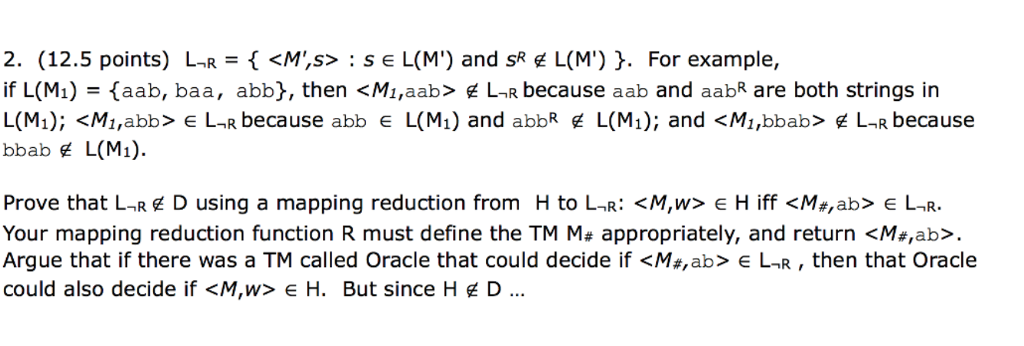
Step by Step Solution
There are 3 Steps involved in it
1 Expert Approved Answer
Step: 1 Unlock

Question Has Been Solved by an Expert!
Get step-by-step solutions from verified subject matter experts
Step: 2 Unlock
Step: 3 Unlock
 Study Help