







Question: 2. [-/2 Points] DETAILS LARCALC11 3.2.011. MY NOTES PRACTICE ANOTHER Determine whether Rolle's Theorem can be applied to f on the closed interval [a, b].
![2. [-/2 Points] DETAILS LARCALC11 3.2.011. MY NOTES PRACTICE ANOTHER Determine](https://s3.amazonaws.com/si.experts.images/answers/2024/06/6679d265b3e16_7496679d2656b5f0.jpg)
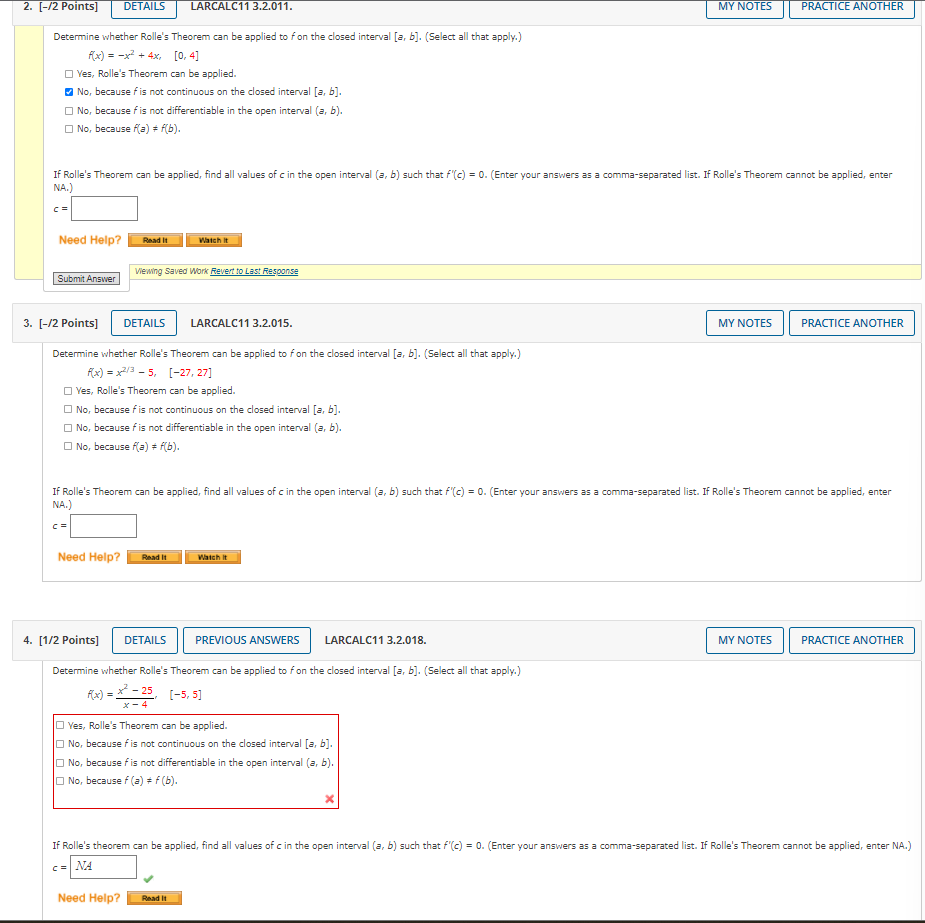
2. [-/2 Points] DETAILS LARCALC11 3.2.011. MY NOTES PRACTICE ANOTHER Determine whether Rolle's Theorem can be applied to f on the closed interval [a, b]. (Select all that apply.) A(x) = -x2 + 4x, [0, 4] O Yes, Rolle's Theorem can be applied. No, because fis not continuous on the closed interval [a, b]. No, because fis not differentiable in the open interval (a, b). O No, because f(a) = Ab). If Rolle's Theorem can be applied, find all values of c in the open interval (a, b) such that /"(c) = 0. (Enter your answers as a comma-separated list. If Rolle's Theorem cannot be applied, enter NA. C = Need Help? Read It Which it Submit Answer Wewing Saved Work Revert to Last Response 3. [-/2 Points] DETAILS LARCALC11 3.2.015. MY NOTES PRACTICE ANOTHER Determine whether Rolle's Theorem can be applied to f on the closed interval [a, b]. (Select all that apply.) (x) = x2/3 - 5, [-27, 27] Yes, Rolle's Theorem can be applied. No, because fis not continuous on the closed interval [a, b]. O No, because f is not differentiable in the open interval (a, b). No, because f(a) = f(b). If Rolle's Theorem can be applied, find all values of c in the open interval (a, b) such that /"(c) = 0. (Enter your answers as a comma-separated list. If Rolle's Theorem cannot be applied, enter NA. Need Help? Read It Watch it 4. [1/2 Points] DETAILS PREVIOUS ANSWERS LARCALC11 3.2.018. MY NOTES PRACTICE ANOTHER Determine whether Rolle's Theorem can be applied to f on the closed interval [a, b]. (Select all that apply.) R(x) = * - 25, [-5, 5] X - 4 Yes, Rolle's Theorem can be applied. No, because f is not continuous on the closed interval [a, b]. No, because f is not differentiable in the open interval (a, b). O No, because f (a) = f (b). If Rolle's theorem can be applied, find all values of c in the open interval (a, b) such that f"(c) = 0. (Enter your answers as a comma-separated list. If Rolle's Theorem cannot be applied, enter NA.) = NA Need Help? Read It
Step by Step Solution
There are 3 Steps involved in it

Get step-by-step solutions from verified subject matter experts
 Study Help