







Question: 2. [-/2 Points] SPRECALCS 4.6.008. ASK YOUR TEACHER PRACTICE ANOTHER It is observed that a certain bacteria culture has a relative growth rate of 19%
![2. [-/2 Points] SPRECALCS 4.6.008. ASK YOUR TEACHER PRACTICE ANOTHER It](https://dsd5zvtm8ll6.cloudfront.net/si.experts.images/questions/2024/10/67096868d163f_80067096868b5372.jpg)
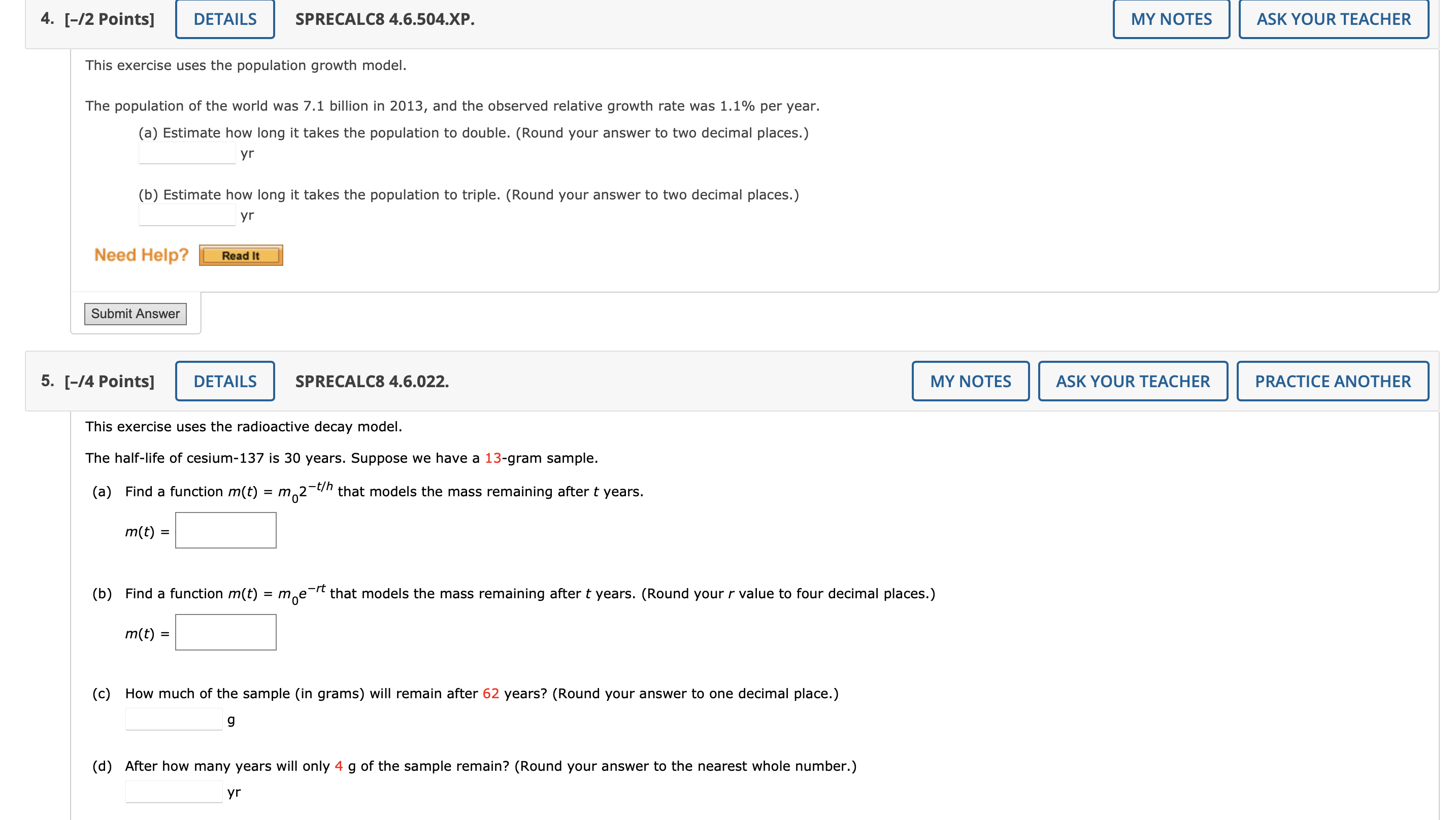
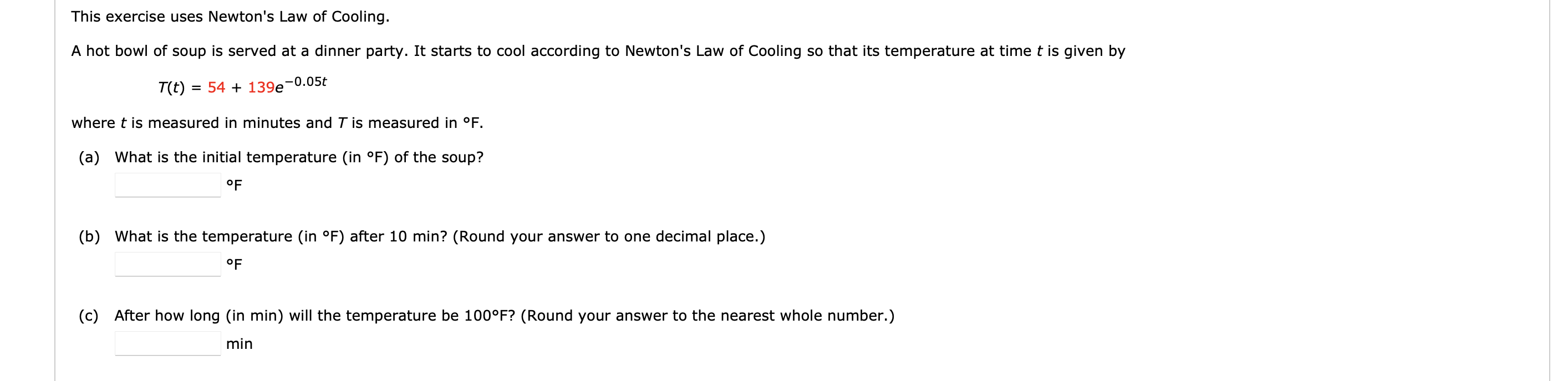
2. [-/2 Points] SPRECALCS 4.6.008. ASK YOUR TEACHER PRACTICE ANOTHER It is observed that a certain bacteria culture has a relative growth rate of 19% per hour, but in the presence of an antibiotic the relative growth rate is reduced to 4% per hour. The initial number of bacteria in the culture is 28. Find the projected population after 24 hours for the following conditions. (Round your answers to the nearest whole number.) This exercise uses the exponential growth model. (a) No antibiotic is present, so the relative growth rate is 19%. bacteria (b) An antibiotic is present in the culture, so the relative growth rate is reduced to 4%. bacteria Need Help? Read It Submit Answer 3. [-/3 Points] SPRECALCS 4.6.503.XP. ASK YOUR TEACHER PRACTICE ANOTHER This exercise uses the population growth model. The population of California was 29.76 million in 1990 and 33.87 million in 2000. Assume that the population grows exponentially. (a) Find a function that models the population (in millions) t years after 1990. (Round your r value to six decimal places.) n(t) = (b) Find the time required after 1990 for the population to double. (Round your answer to one decimal place.) yr (c) Use the function from part (a) to predict the population of California in the year 2003. (Round your answer to two decimal places.) million Need Help? Submit Answer ASK YOUR TEACHER 4. [-/2 Points] SPRECALCS 4.6.504.XP. This exercise uses the population growth model. The population of the world was 7.1 billion in 2013, and the observed relative growth rate was 1.1% per year. (a) Estimate how long it takes the population to double. (Round your answer to two decimal places.) yr (b) Estimate how long it takes the population to triple. (Round your answer to two decimal places.) yr Need Help? Read It Submit Answer 5. [-/4 Points] SPRECALCS 4.6.022. ASK YOUR TEACHER PRACTICE ANOTHER This exercise uses the radioactive decay model. The half-life of cesium-137 is 30 years. Suppose we have a 13-gram sample. (a) Find a function m(t) = mOZ_t/h that models the mass remaining after t years. m(t) = (b) Find a function m(t) = moe"t that models the mass remaining after t years. (Round your r value to four decimal places.) m(t) = (c) How much of the sample (in grams) will remain after 62 years? (Round your answer to one decimal place.) 9 (d) After how many years will only 4 g of the sample remain? (Round your answer to the nearest whole number.) yr This exercise uses Newton's Law of Cooling. A hot bowl of soup is served at a dinner party. It starts to cool according to Newton's Law of Cooling so that its temperature at time t is given by T(t) = 54 + 13970-05 where t is measured in minutes and T is measured in F. (a) What is the initial temperature (in F) of the soup? F (b) What is the temperature (in F) after 10 min? (Round your answer to one decimal place.) F (c) After how long (in min) will the temperature be 100F? (Round your answer to the nearest whole number.) min
Step by Step Solution
There are 3 Steps involved in it

Get step-by-step solutions from verified subject matter experts
 Study Help