







Question: 2. (25 points) A CMAS treatment system is being designed for a municipal wastewater and the following operating conditions: Effluent flow of 10,000 m3/d leaving
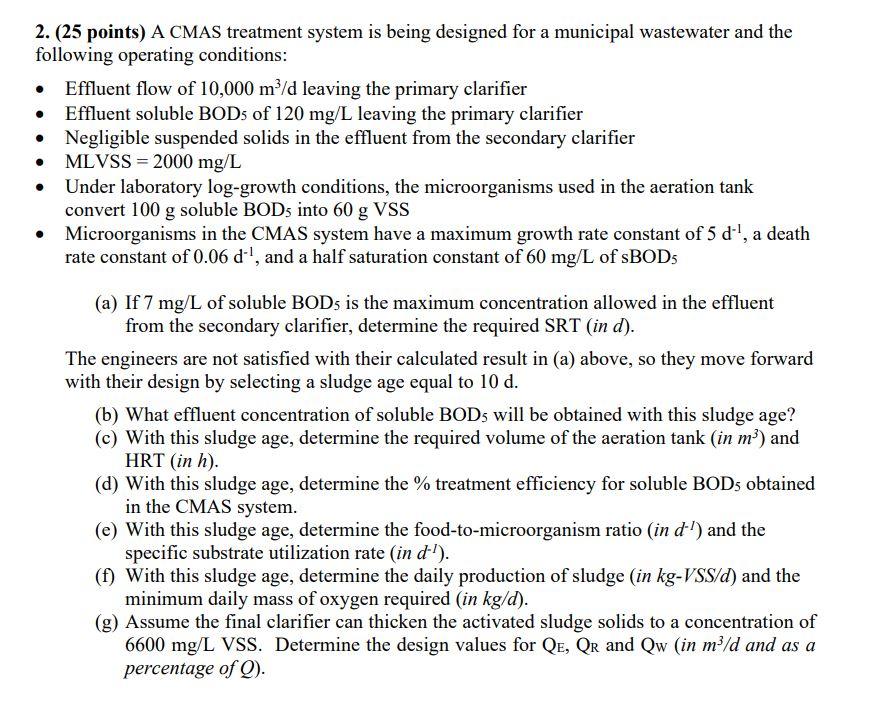
2. (25 points) A CMAS treatment system is being designed for a municipal wastewater and the following operating conditions: Effluent flow of 10,000 m3/d leaving the primary clarifier Effluent soluble BODs of 120 mg/L leaving the primary clarifier Negligible suspended solids in the effluent from the secondary clarifier MLVSS = 2000 mg/L Under laboratory log-growth conditions, the microorganisms used in the aeration tank convert 100 g soluble BODs into 60 g VSS Microorganisms in the CMAS system have a maximum growth rate constant of 5 d'', a death rate constant of 0.06 d!, and a half saturation constant of 60 mg/L of SBODs . (a) If 7 mg/L of soluble BOD5 is the maximum concentration allowed in the effluent from the secondary clarifier, determine the required SRT (in d). The engineers are not satisfied with their calculated result in (a) above, so they move forward with their design by selecting a sludge age equal to 10 d. (b) What effluent concentration of soluble BODs will be obtained with this sludge age? (c) With this sludge age, determine the required volume of the aeration tank (in m) and HRT (in h). (d) With this sludge age, determine the % treatment efficiency for soluble BODs obtained in the CMAS system. (e) With this sludge age, determine the food-to-microorganism ratio (in d') and the specific substrate utilization rate (in d!). (f) With this sludge age, determine the daily production of sludge (in kg-VSS/d) and the minimum daily mass of oxygen required (in kg/d). (g) Assume the final clarifier can thicken the activated sludge solids to a concentration of 6600 mg/L VSS. Determine the design values for QE, QR and Qw (in m/d and as a percentage of 9)
Step by Step Solution
There are 3 Steps involved in it

Get step-by-step solutions from verified subject matter experts
 Study Help