







Question: 2 3 . 1 2 . 2 0 2 3 HEAT TRANSFER PROJECT WORK Water is desired to be heated from 1 0 C to
HEAT TRANSFER PROJECT WORK
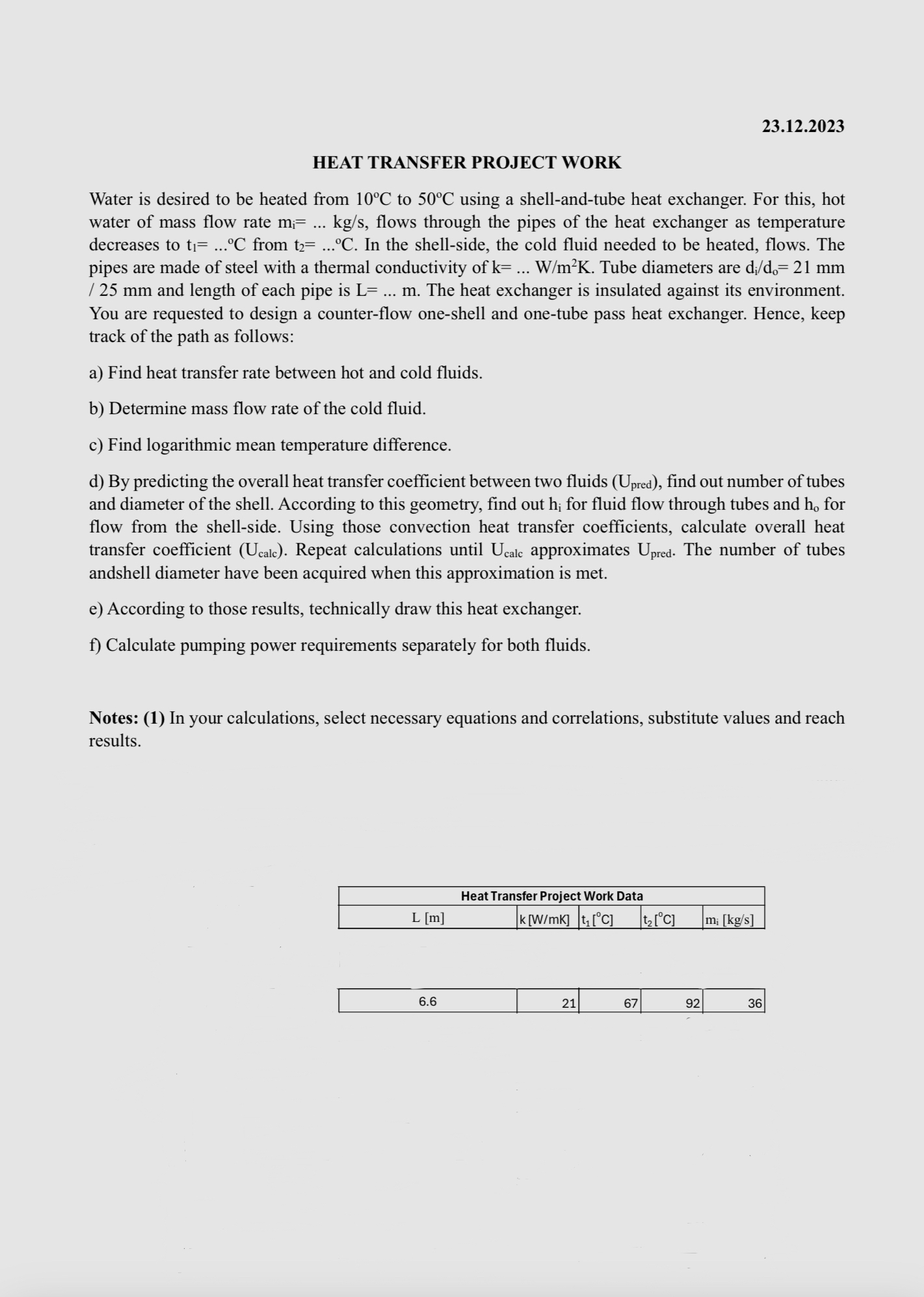
Water is desired to be heated from to using a shellandtube heat exchanger. For this, hot water of mass flow rate dotsk flows through the pipes of the heat exchanger as temperature decreases to dots from dots In the shellside, the cold fluid needed to be heated, flows. The pipes are made of steel with a thermal conductivity of dots Tube diameters are mm and length of each pipe is dotsm. The heat exchanger is insulated against its environment. You are requested to design a counterflow oneshell and onetube pass heat exchanger. Hence, keep track of the path as follows:
a Find heat transfer rate between hot and cold fluids.
b Determine mass flow rate of the cold fluid.
c Find logarithmic mean temperature difference.
d By predicting the overall heat transfer coefficient between two fluids find out number of tubes and diameter of the shell. According to this geometry, find out for fluid flow through tubes and for flow from the shellside. Using those convection heat transfer coefficients, calculate overall heat transfer coefficient Repeat calculations until approximates The number of tubes andshell diameter have been acquired when this approximation is met.
e According to those results, technically draw this heat exchanger.
f Calculate pumping power requirements separately for both fluids.
Notes: In your calculations, select necessary equations and correlations, substitute values and reach results.
tableHeat Transfer Project Work Data
Step by Step Solution
There are 3 Steps involved in it
1 Expert Approved Answer
Step: 1 Unlock

Question Has Been Solved by an Expert!
Get step-by-step solutions from verified subject matter experts
Step: 2 Unlock
Step: 3 Unlock
 Study Help