







Question: 2 / 3 100% 2. Consider the ARMA(1,1) process defined by: x[n] = -a x[n 1] + bon[n] + b [n 1] where v[n] is
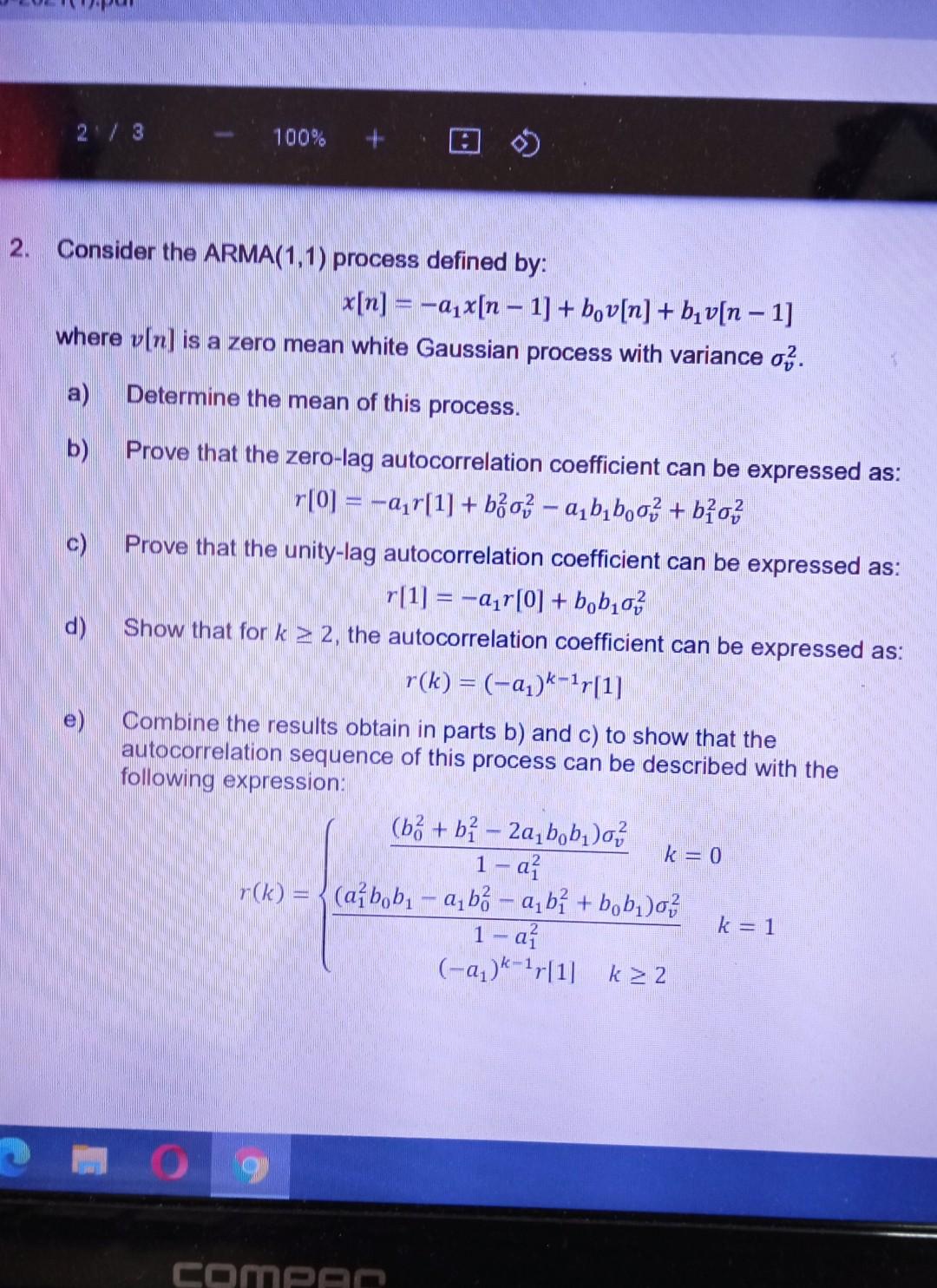
2 / 3 100% 2. Consider the ARMA(1,1) process defined by: x[n] = -a x[n 1] + bon[n] + b [n 1] where v[n] is a zero mean white Gaussian process with variance oz. a) Determine the mean of this process. b) c) d) Prove that the zero-lag autocorrelation coefficient can be expressed as: r[0] = -ar[1] + bo} a baboo + bo Prove that the unity-lag autocorrelation coefficient can be expressed as: r[1] = -a,r[0] + bob 03 Show that for k = 2, the autocorrelation coefficient can be expressed as: r(k)= (-a)k-18[1] Combine the results obtain in parts b) and c) to show that the autocorrelation sequence of this process can be described with the following expression: (b3 + b 2abb, Dog k = 0 1 -a r(k) = {(abob - az b - a b + bobz) 03 k=1 1 - a (-a)k-15[1] k> 2 e) COMPAN 2 / 3 100% 2. Consider the ARMA(1,1) process defined by: x[n] = -a x[n 1] + bon[n] + b [n 1] where v[n] is a zero mean white Gaussian process with variance oz. a) Determine the mean of this process. b) c) d) Prove that the zero-lag autocorrelation coefficient can be expressed as: r[0] = -ar[1] + bo} a baboo + bo Prove that the unity-lag autocorrelation coefficient can be expressed as: r[1] = -a,r[0] + bob 03 Show that for k = 2, the autocorrelation coefficient can be expressed as: r(k)= (-a)k-18[1] Combine the results obtain in parts b) and c) to show that the autocorrelation sequence of this process can be described with the following expression: (b3 + b 2abb, Dog k = 0 1 -a r(k) = {(abob - az b - a b + bobz) 03 k=1 1 - a (-a)k-15[1] k> 2 e) COMPAN
Step by Step Solution
There are 3 Steps involved in it

Get step-by-step solutions from verified subject matter experts
 Study Help