







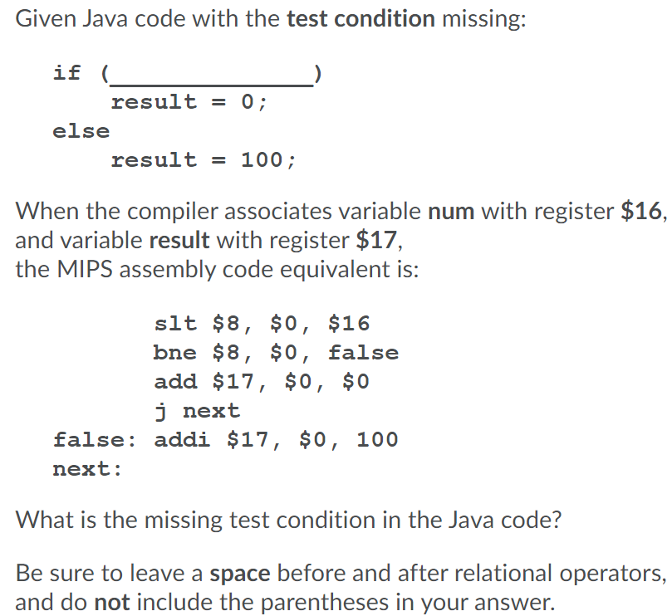
Question: 2 3 Given Java code with the test condition missing: if result = 0; else result = 100; When the compiler associates variable num with
2
3
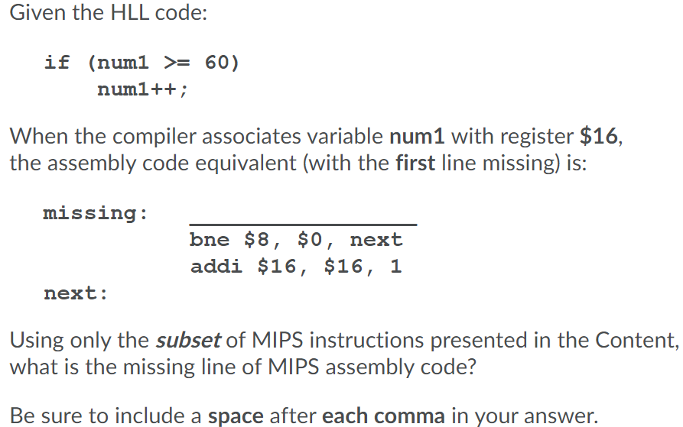
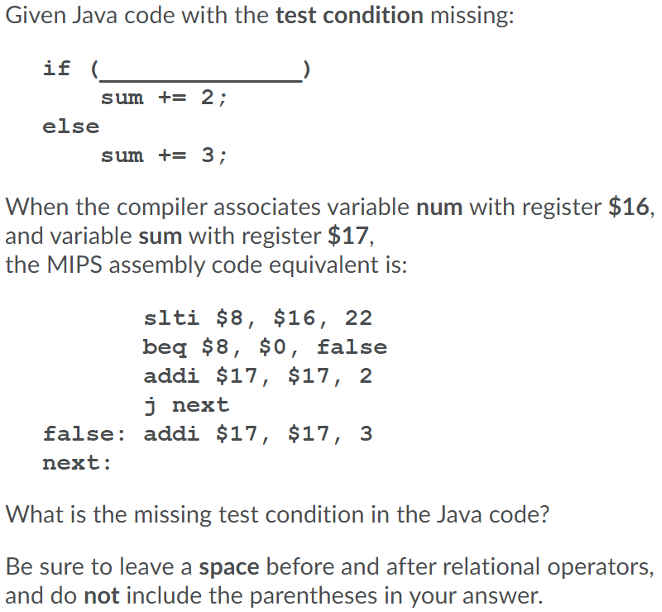
Given Java code with the test condition missing: if result = 0; else result = 100; When the compiler associates variable num with register $16, and variable result with register $17, the MIPS assembly code equivalent is: slt $ 8, $ 0, $16 bne $ 8, $0, false add $17, $ 0, $ 0 j next false: addi $17, $0, 100 next: What is the missing test condition in the Java code? Be sure to leave a space before and after relational operators, and do not include the parentheses in your answer. Given Java code with the test condition missing: if ( sum += 2; else sum += 3; When the compiler associates variable num with register $16, and variable sum with register $17, the MIPS assembly code equivalent is: slti $8, $16, 22 beq $8, $0, false addi $17, $17, 2 j next false: addi $17, $17, 3 next: What is the missing test condition in the Java code? Be sure to leave a space before and after relational operators, and do not include the parentheses in your answer. Given the HLL code: if (numi >= 60) num1++; When the compiler associates variable num1 with register $16, the assembly code equivalent (with the first line missing) is: missing: bne $ 8, $0, next addi $16, $16, 1 next: Using only the subset of MIPS instructions presented in the Content, what is the missing line of MIPS assembly code? Be sure to include a space after each comma in your
Step by Step Solution
There are 3 Steps involved in it

Get step-by-step solutions from verified subject matter experts
 Study Help