







Question: 2 . 3 . Graph Representation The adjacency matrix is a useful graph representation for many analytical calculations. However, when we need to store a
Graph Representation
The adjacency matrix is a useful graph representation for many analytical calculations. However, when we need to store a network in a computer, we can save computer memory by offering the list of links in a Lx matrix, whose rows contain the starting and end point i and j of each link.
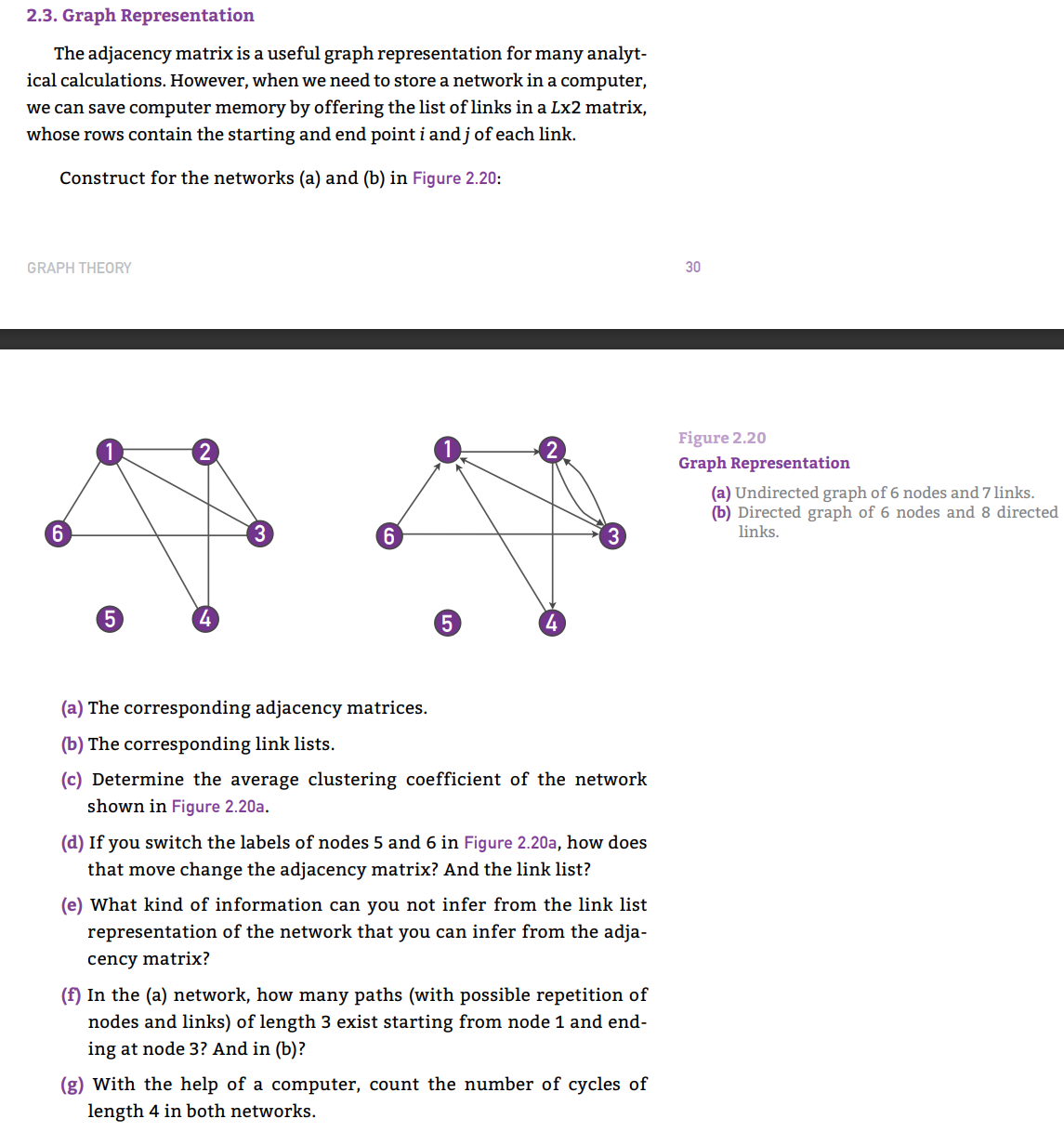
Construct for the networks a and b in Figure :
GRAPH THEORY
a The corresponding adjacency matrices.
b The corresponding link lists.
c Determine the average clustering coefficient of the network shown in Figure a
d If you switch the labels of nodes and in Figure a how does that move change the adjacency matrix? And the link list?
e What kind of information can you not infer from the link list representation of the network that you can infer from the adjacency matrix?
f In the a network, how many paths with possible repetition of nodes and links of length exist starting from node and ending at node And in b
g With the help of a computer, count the number of cycles of length in both networks.
Figure
Graph Representation
a Undirected graph of nodes and links.
b Directed graph of nodes and directed links.
Step by Step Solution
There are 3 Steps involved in it
1 Expert Approved Answer
Step: 1 Unlock

Question Has Been Solved by an Expert!
Get step-by-step solutions from verified subject matter experts
Step: 2 Unlock
Step: 3 Unlock
 Study Help