







Question: 2. (3 points) Throughout this course, we assume that parameter passing during procedure calls takes constant time, even if an N-element array is being passed.
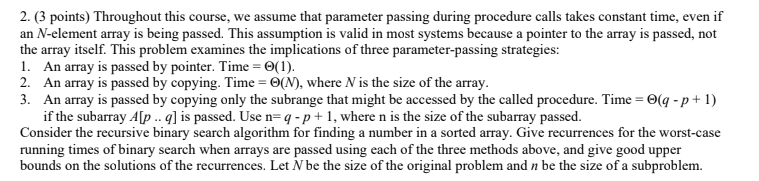
2. (3 points) Throughout this course, we assume that parameter passing during procedure calls takes constant time, even if an N-element array is being passed. This assumption is valid in most systems because a pointer to the array is passed, not the array itself. This problem examines the implications of three parameter-passing strategies: 1. An array is passed by pointer. Time = @(1). 2. An array is passed by copying. Time = (N), where N is the size of the array. 3. An array is passed by copying only the subrange that might be accessed by the called procedure. Time = @(9-p+1) if the subarray A[p..g] is passed. Use n=9-p+1, where n is the size of the subarray passed. Consider the recursive binary search algorithm for finding a number in a sorted array. Give recurrences for the worst-case running times of binary search when arrays are passed using each of the three methods above, and give good upper bounds on the solutions of the recurrences. Let N be the size of the original problem and n be the size of a sub
Step by Step Solution
There are 3 Steps involved in it

Get step-by-step solutions from verified subject matter experts
 Study Help