







Question: 2. 4. 1. A peril is defined as: a) the proximate cause of the loss (easy) b) the chance a loss will occur c) a
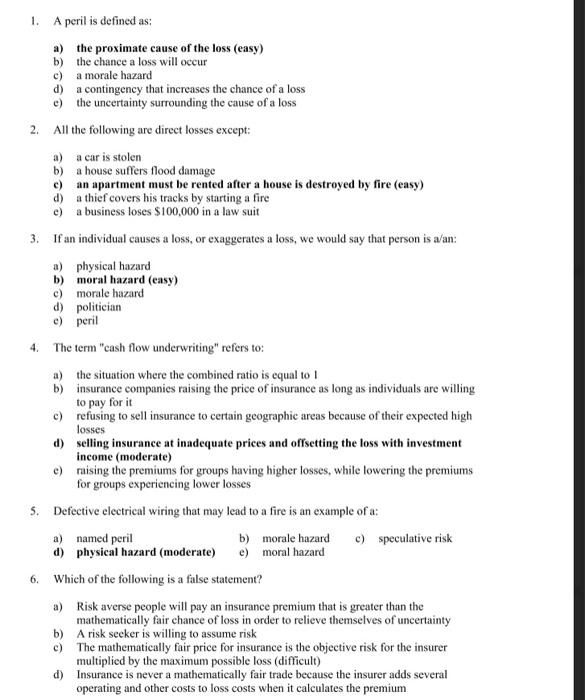
2. 4. 1. A peril is defined as: a) the proximate cause of the loss (easy) b) the chance a loss will occur c) a morale hazard d) a contingency that increases the chance of a loss e) the uncertainty surrounding the cause of a loss All the following are direct losses except: a) a car is stolen b) a house suffers flood damage c) an apartment must be rented after a house is destroyed by fire (easy) d) a thief covers his tracks by starting a fire e) a business loses $100,000 in a law suit 3. If an individual causes a loss, or exaggerates a loss, we would say that person is aan: a) physical hazard b) moral hazard (easy) c) morale hazard d) politician e) peril The term "cash flow underwriting" refers to: a) the situation where the combined ratio is equal to 1 b) insurance companies raising the price of insurance as long as individuals are willing to pay for it c) refusing to sell insurance to certain geographic areas because of their expected high losses d) selling insurance at inadequate prices and offsetting the loss with investment income (moderate) e) raising the premiums for groups having higher losses, while lowering the premiums for groups experiencing lower losses 5. Defective electrical wiring that may lead to a fire is an example of a: a) named peril b) morale hazard c) speculative risk d) physical hazard (moderate) e) moral hazard Which of the following is a false statement? a) Risk averse people will pay an insurance premium that is greater than the mathematically fair chance of loss in order to relieve themselves of uncertainty b) A risk seeker is willing to assume risk c) The mathematically fair price for insurance is the objective risk for the insurer multiplied by the maximum possible loss (difficult) d) Insurance is never a mathematically fair trade because the insurer adds several operating and other costs to loss costs when it calculates the premium 6
Step by Step Solution
There are 3 Steps involved in it

Get step-by-step solutions from verified subject matter experts
 Study Help