







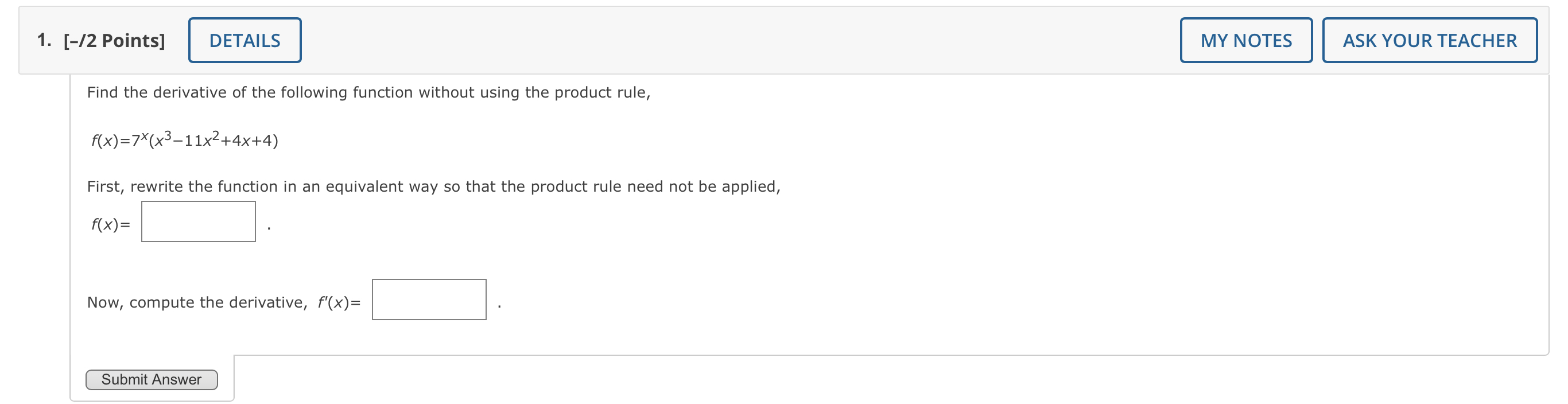
Question: 2. [-/4 Points] DETAILS MY NOTES ASK YOUR TEACHER Find the derivative of each of he following functions, a. f(x)=(1+x+x2)99 rm = 1+5 b' m5):
![2. [-/4 Points] DETAILS MY NOTES ASK YOUR TEACHER Find the](https://s3.amazonaws.com/si.experts.images/answers/2024/06/6667099867e75_69666670998447fb.jpg)
![b' m5): sZ3s+22 M'(s)= d. l'(z)=7{"z'12 1"(2): Submit Answer 1. [-/2 Points]](https://s3.amazonaws.com/si.experts.images/answers/2024/06/6667099955393_6976667099935556.jpg)
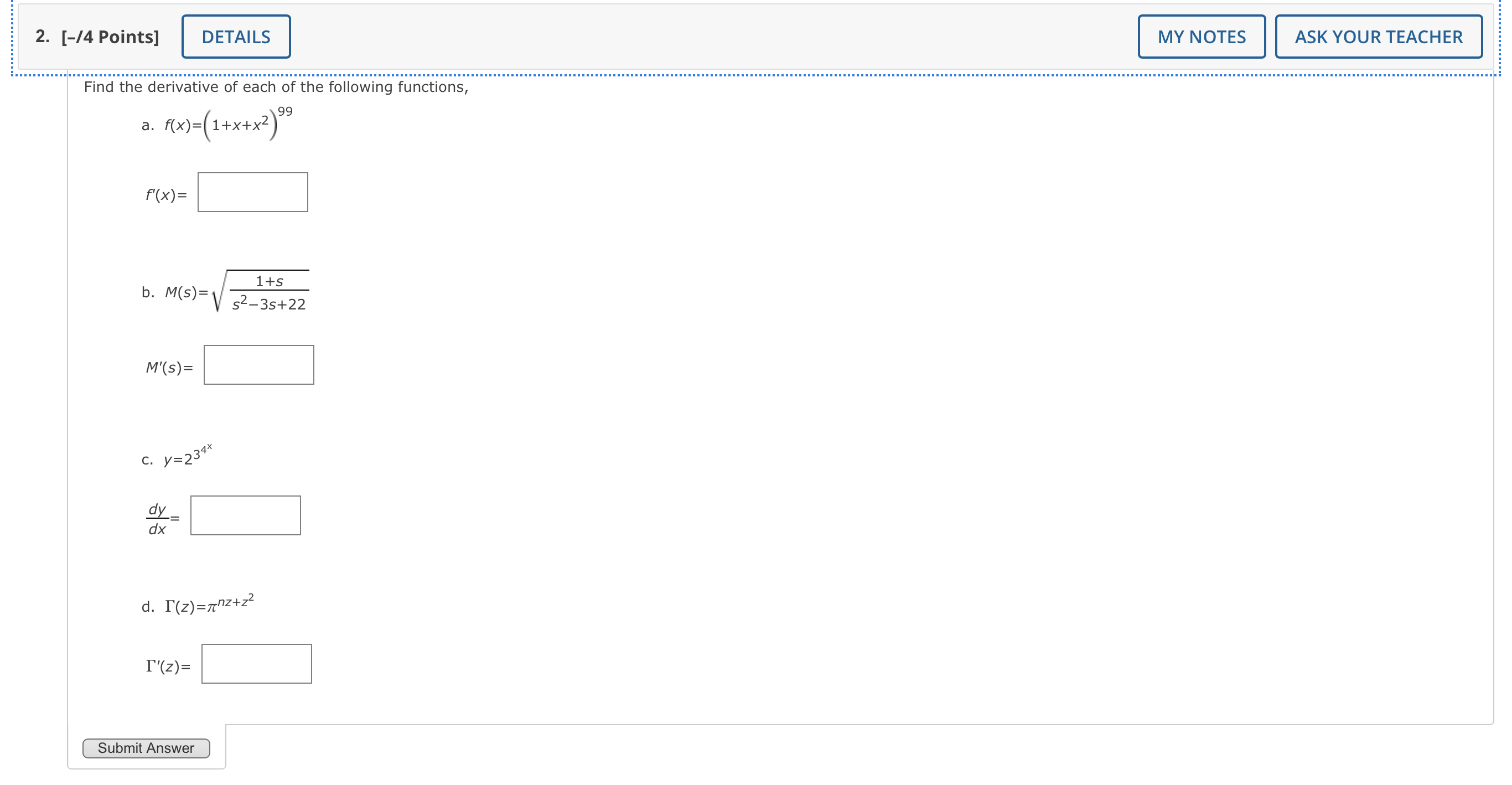
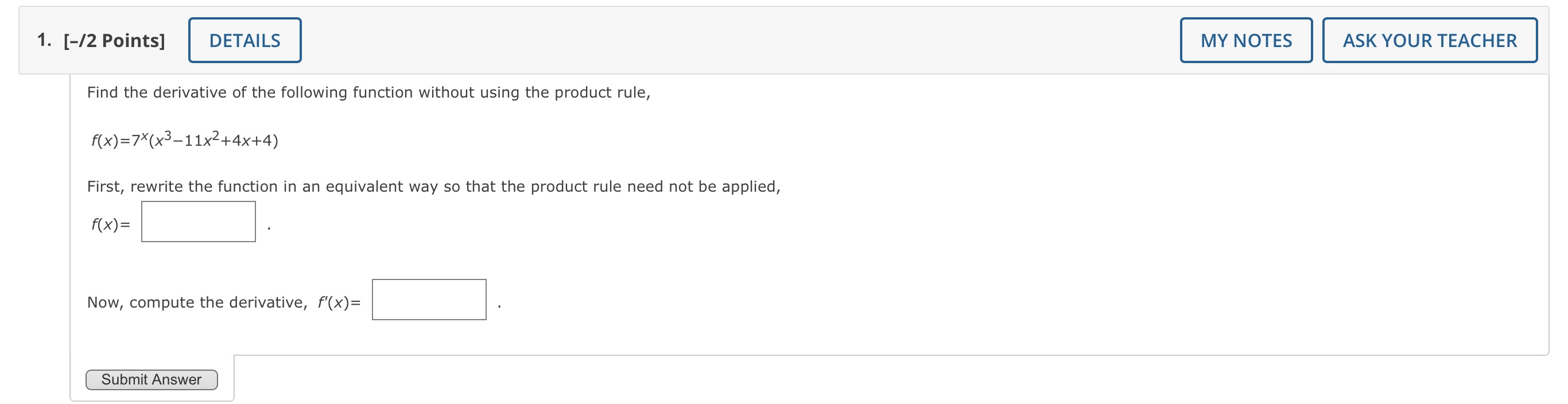
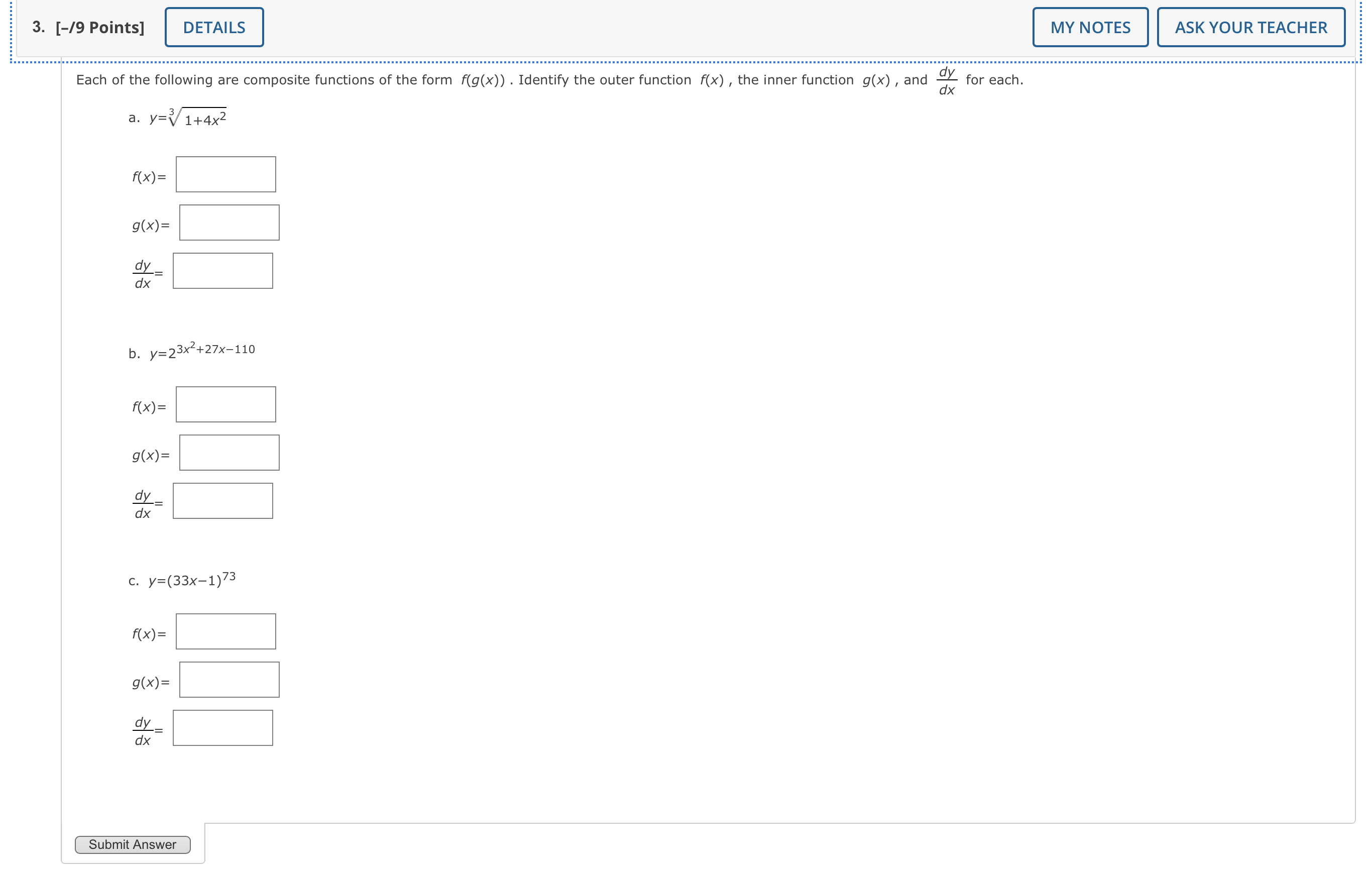
2. [-/4 Points] DETAILS MY NOTES ASK YOUR TEACHER Find the derivative of each of he following functions, a. f(x)=(1+x+x2)99 rm = 1+5 b' m5): sZ3s+22 M'(s)= d. l'(z)=7{"z'12 1"(2): Submit Answer 1. [-/2 Points] DETAILS MY NOTES ASK YOUR TEACHER Find the derivative of the following function without using the product rule, f(x)=7*(x3-11x2+4x+4) First, rewrite the function in an equivalent way so that the product rule need not be applied, f ( x ) = Now, compute the derivative, f(x)= Submit Answer3. [-/9 Points] DETAILS MY NOTES ASK YOUR TEACHER Each of the following are composite functions of the form f(g(x) ) . Identify the outer function f(x) , the inner function g(x) , and - for each. a. y= V 1+4x2 f ( x) = g ( x ) = dx b. y=23x2+27x-110 f ( x ) = g ( x ) = dy dx c. y=(33x-1) 73 f ( x ) = g ( x ) = dy = dx Submit
Step by Step Solution
There are 3 Steps involved in it

Get step-by-step solutions from verified subject matter experts
 Study Help