







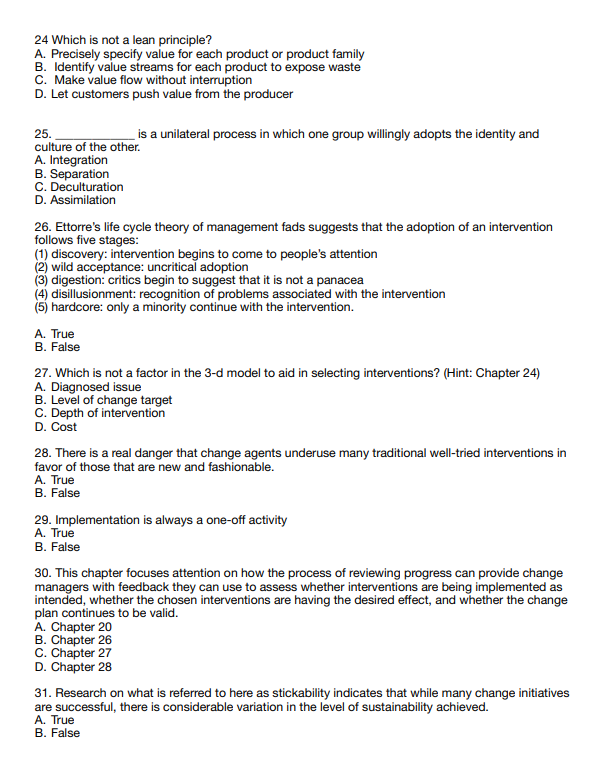
Question: 2 4 Which is not a lean principle? A . Precisely specify value for each product or product family B . Identify value streams for
Which is not a lean principle?
A Precisely specify value for each product or product family
B Identify value streams for each product to expose waste
C Make value flow without interruption
D Let customers push value from the producer
is a unilateral process in which one group willingly adopts the identity and
culture of the other.
A Integration
B Separation
C Deculturation
D Assimilation
Ettorre's life cycle theory of management fads suggests that the adoption of an intervention
follows five stages:
discovery: intervention begins to come to people's attention
wild acceptance: uncritical adoption
digestion: critics begin to suggest that it is not a panacea
disillusionment: recognition of problems associated with the intervention
hardcore: only a minority continue with the intervention.
A True
B False
Which is not a factor in the d model to aid in selecting interventions? Hint: Chapter
A Diagnosed issue
B Level of change target
C Depth of intervention
D Cost
There is a real danger that change agents underuse many traditional welltried interventions in
favor of those that are new and fashionable.
A True
B False
Implementation is always a oneoff activity
A True
B False
This chapter focuses attention on how the process of reviewing progress can provide change
managers with feedback they can use to assess whether interventions are being implemented as
intended, whether the chosen interventions are having the desired effect, and whether the change
plan continues to be valid.
A Chapter
B Chapter
C Chapter
D Chapter
Research on what is referred to here as stickability indicates that while many change initiatives
are successful, there is considerable variation in the level of sustainability achieved.
A True
B False Many of the factors that promote stickability also support spread. The manner in which a
change is spread can influence the degree to which it will be sustained. When changes are rolled
out hastily, without much consultation, with few incentives and inadequate training, they may
quickly decay. Similarly, changes that do not have support and are not sustained are unlikely to
spread elsewhere.
A True
B False
Which is not a factor that can affect spread:
A Attributes of the innovation
B Context reflected by the organisation's climate for implementation
C The values of potential users, and their perception of the extent to which the innovation will
foster or inhibit the fulfilment of their values.
D All of the above, A B and C are all factors that affect spread
Questions are based on PPTs OCM How to Change by Katy Milkman
Why is it that these tools and techniques designed to spur change so often fail?
One answer is that change is hard. But a more useful answer is that you haven't found the right
strategy. You'll get further faster if you
your strategy: isolate the weakness
preventing progress, and then pounce.
A customize
B generalize
C popularize
D verbalize
What is a good strategy for solving the problem of impulsivity?
A present bias
B temptation bundling
C fresh start
D implementation intention
Whenever you do something that reduces your own freedoms in the service of a greater goal.
A forgetfulness
B planning prompt
C formal checklist
D commitment device
Laziness can be an asset. And not just when it comes to efficiency.
When laziness is appropriately harnessed, it can actually help facilitate change.
Laziness is the path of least resistance, so it conserves energy. It's a shortcut. Habits also
conserve energy.
A True
B False
She watched peers who had managed to achieve a goal she wanted to achieve and then
deliberately imitated their methods.
A Copy and paste
B Social accountability
C Crooning
D False consensus effect Questions are based on the article, Leading Change: Why Transformation Efforts Fail by
John Kotter.
Which is not a reason why change efforts fail?
A Not establishing a great enough sense of urgency
B Lacking a vision
C Not anchoring changes in the corporation's culture
D Planning for and creating short term wins
Which statement is false?
A The most general lesson to be learned from the more successful cases is that the change
process goes through a series of phases that, in total, usually require a considerable length of
time.
B A second very general lesson is that critical mistakes in any of the phases can have a
devastating impact, slowing momentum and negating hardwon gains.
C Compared with other steps in the change process, phase one can sound easy. It is not. Well
over of the companies I have watched fail in this first phase.
D A useful rule of thumb: you need at least thirty minutes to communicate the vision. It should be
complex.
Step by Step Solution
There are 3 Steps involved in it
1 Expert Approved Answer
Step: 1 Unlock

Question Has Been Solved by an Expert!
Get step-by-step solutions from verified subject matter experts
Step: 2 Unlock
Step: 3 Unlock
 Study Help