







Question: 2. (4+2+2+2+2+2 points) Multidimensional integrals. When we first talk about one- dimensional integrals, we are integrating a length (the distance between f(x) and the x-
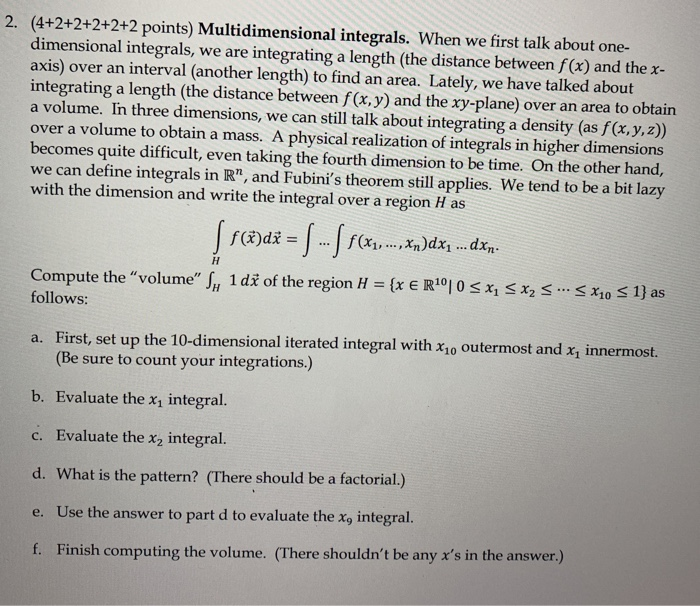
2. (4+2+2+2+2+2 points) Multidimensional integrals. When we first talk about one- dimensional integrals, we are integrating a length (the distance between f(x) and the x- axis) over an interval (another length) to find an area. Lately, we have talked about integrating a length (the distance between f(x,y) and the xy-plane) over an area to obtain a volume. In three dimensions, we can still talk about integrating a density (as f(x,y,z)) over a volume to obtain a mass. A physical realization of integrals in higher dimensions becomes quite difficult, even taking the fourth dimension to be time. On the other hand, we can define integrals in R", and Fubini's theorem still applies. We tend to be a bit lazy with the dimension and write the integral over a region H as ..., Xn)dx ... dxn Compute the "volume" S. 1 di of the region H = {x R100 SX SX, S. 5X10 1} as follows: a. First, set up the 10-dimensional iterated integral with X10 outermost and x, innermost. (Be sure to count your integrations.) b. Evaluate the x1 integral. c. Evaluate the x, integral. d. What is the pattern? (There should be a factorial.) e. Use the answer to part d to evaluate the X, integral. f. Finish computing the volume. (There shouldn't be any x's in the answer.) 2. (4+2+2+2+2+2 points) Multidimensional integrals. When we first talk about one- dimensional integrals, we are integrating a length (the distance between f(x) and the x- axis) over an interval (another length) to find an area. Lately, we have talked about integrating a length (the distance between f(x,y) and the xy-plane) over an area to obtain a volume. In three dimensions, we can still talk about integrating a density (as f(x,y,z)) over a volume to obtain a mass. A physical realization of integrals in higher dimensions becomes quite difficult, even taking the fourth dimension to be time. On the other hand, we can define integrals in R", and Fubini's theorem still applies. We tend to be a bit lazy with the dimension and write the integral over a region H as ..., Xn)dx ... dxn Compute the "volume" S. 1 di of the region H = {x R100 SX SX, S. 5X10 1} as follows: a. First, set up the 10-dimensional iterated integral with X10 outermost and x, innermost. (Be sure to count your integrations.) b. Evaluate the x1 integral. c. Evaluate the x, integral. d. What is the pattern? (There should be a factorial.) e. Use the answer to part d to evaluate the X, integral. f. Finish computing the volume. (There shouldn't be any x's in the answer.)
Step by Step Solution
There are 3 Steps involved in it

Get step-by-step solutions from verified subject matter experts
 Study Help