







Question: ( 2 5 points ) Ammonia Absorption Air Conditioner An engineer wanting to reduce the carbon footprint of their house designs an air conditioning system
points Ammonia Absorption Air Conditioner
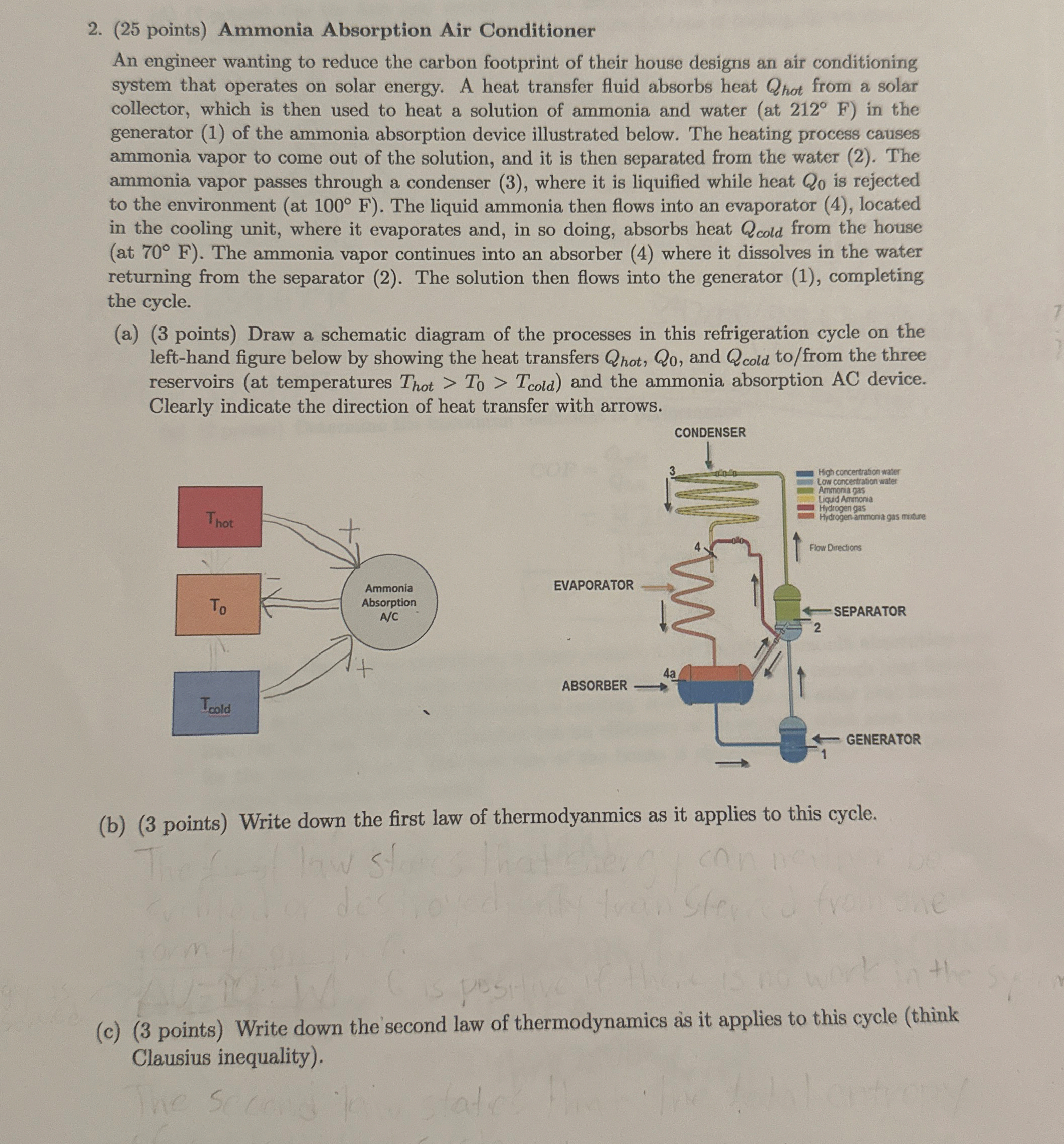
An engineer wanting to reduce the carbon footprint of their house designs an air conditioning system that operates on solar energy. A heat transfer fluid absorbs heat from a solar collector, which is then used to heat a solution of ammonia and water at in the generator of the ammonia absorption device illustrated below. The heating process causes ammonia vapor to come out of the solution, and it is then separated from the water The ammonia vapor passes through a condenser where it is liquified while heat is rejected to the environment at The liquid ammonia then flows into an evaporator located in the cooling unit, where it evaporates and, in so doing, absorbs heat from the house at The ammonia vapor continues into an absorber where it dissolves in the water returning from the separator The solution then flows into the generator completing the cycle.
a points Draw a schematic diagram of the processes in this refrigeration cycle on the lefthand figure below by showing the heat transfers and tofrom the three reservoirs at temperatures and the ammonia absorption AC device. Clearly indicate the direction of heat transfer with arrows.
b points Write down the first law of thermodyanmics as it applies to this cycle.
c points Write down the second law of thermodynamics s it applies to this cycle think Clausius inequality
Step by Step Solution
There are 3 Steps involved in it
1 Expert Approved Answer
Step: 1 Unlock

Question Has Been Solved by an Expert!
Get step-by-step solutions from verified subject matter experts
Step: 2 Unlock
Step: 3 Unlock
 Study Help