







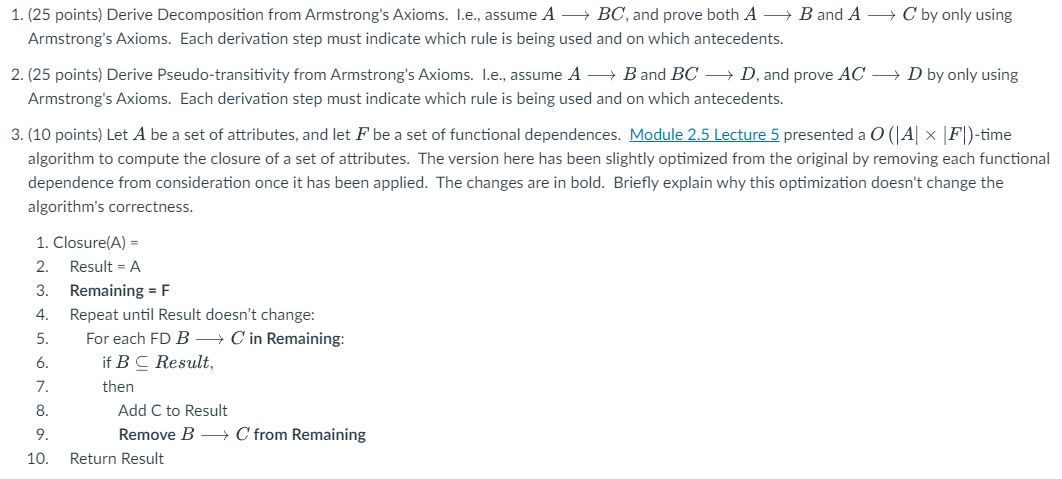
Question: ( 2 5 points ) Derive Decomposition from Armstrong's Axioms. I.e . , assume AlongrightarrowBC, and prove both AlongrightarrowB and AlongrightarrowC by only using Armstrong's
points Derive Decomposition from Armstrong's Axioms. I.e assume AlongrightarrowBC, and prove both AlongrightarrowB and AlongrightarrowC by only using
Armstrong's Axioms. Each derivation step must indicate which rule is being used and on which antecedents.
points Derive Pseudotransitivity from Armstrong's Axioms. I.e assume AlongrightarrowB and BClongrightarrowD, and prove AClongrightarrowD by only using
Armstrong's Axioms. Each derivation step must indicate which rule is being used and on which antecedents.
points Let be a set of attributes, and let be a set of functional dependences. Module Lecture presented a time
algorithm to compute the closure of a set of attributes. The version here has been slightly optimized from the original by removing each functional
dependence from consideration once it has been applied. The changes are in bold. Briefly explain why this optimization doesn't change the
algorithm's correctness.
Closure
Result
Remaining
Repeat until Result doesn't change:
For each FD BlongrightarrowC in Remaining:
if Bsube Result,
then
Add to Result
Remove BlongrightarrowC from Remaining
Return Result
Step by Step Solution
There are 3 Steps involved in it
1 Expert Approved Answer
Step: 1 Unlock

Question Has Been Solved by an Expert!
Get step-by-step solutions from verified subject matter experts
Step: 2 Unlock
Step: 3 Unlock
 Study Help