







Question: 2. (5 points) (Mechanical Questions) a) (1 point) We have estimated the mean of a population to be 7.5. The 95% confidence interval for our
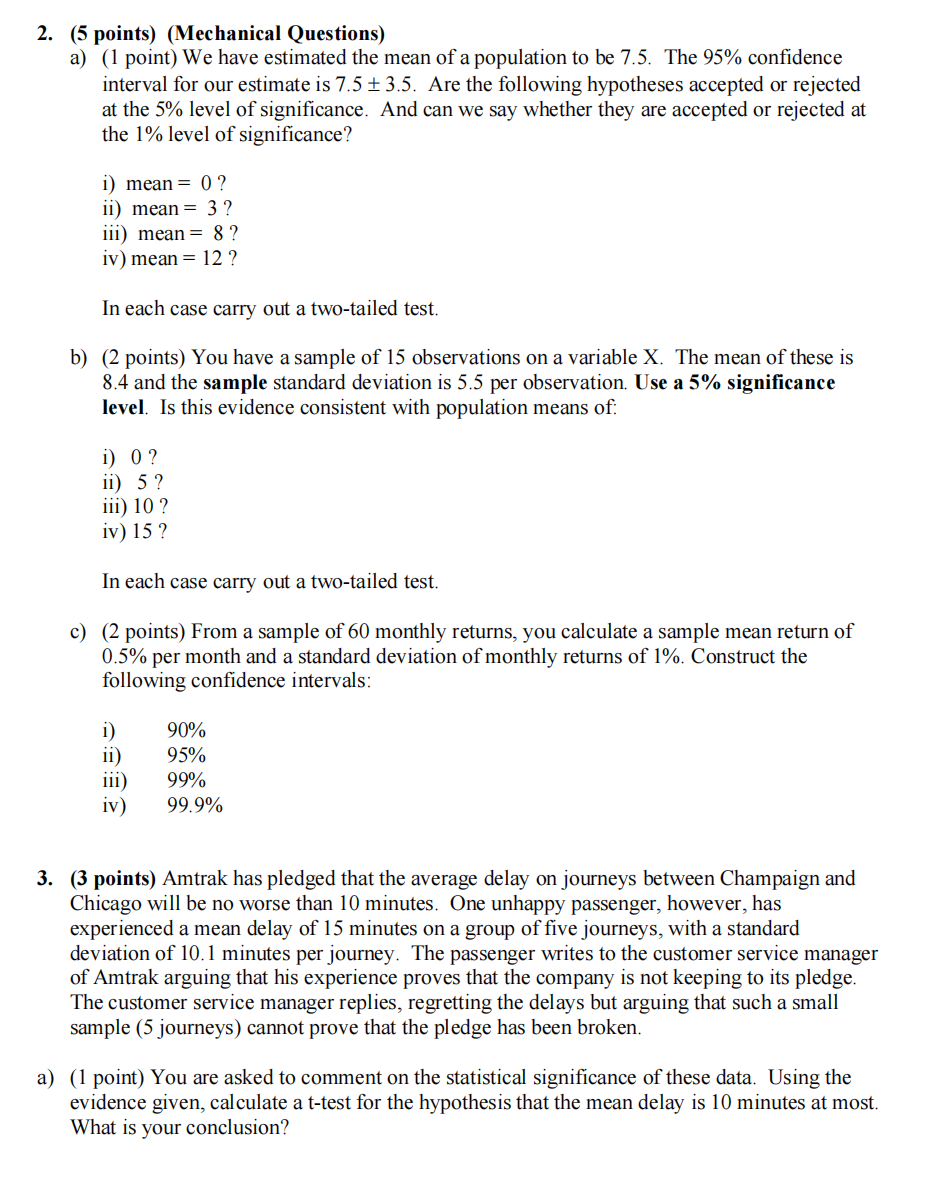
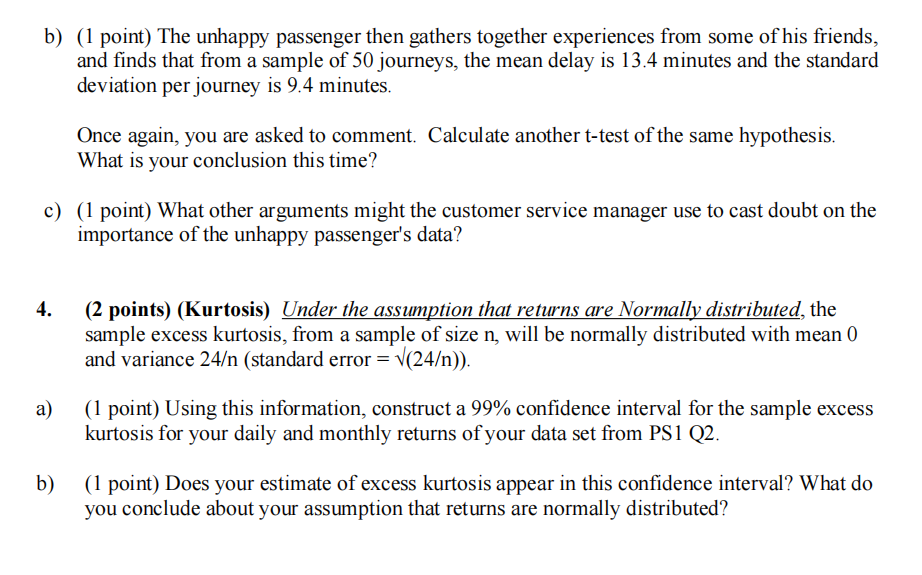
2. (5 points) (Mechanical Questions) a) (1 point) We have estimated the mean of a population to be 7.5. The 95% confidence interval for our estimate is 7.5 + 3.5. Are the following hypotheses accepted or rejected at the 5% level of significance. And can we say whether they are accepted or rejected at the 1% level of significance? i) mean = 0 ? ii) mean = 3 ? iii) mean = 8 ? iv) mean = 12 ? In each case carry out a two-tailed test. b) (2 points) You have a sample of 15 observations on a variable X. The mean of these is 8.4 and the sample standard deviation is 5.5 per observation. Use a 5% significance level. Is this evidence consistent with population means of: i) 0 ? ii) 5 ? iii) 10 ? iv) 15 ? In each case carry out a two-tailed test. c) (2 points) From a sample of 60 monthly returns, you calculate a sample mean return of 0.5% per month and a standard deviation of monthly returns of 1%. Construct the following confidence intervals: 1) 90% ii ) 95% iii ) 99% iv) 99.9% 3. (3 points) Amtrak has pledged that the average delay on journeys between Champaign and Chicago will be no worse than 10 minutes. One unhappy passenger, however, has experienced a mean delay of 15 minutes on a group of five journeys, with a standard deviation of 10.1 minutes per journey. The passenger writes to the customer service manager of Amtrak arguing that his experience proves that the company is not keeping to its pledge. The customer service manager replies, regretting the delays but arguing that such a small sample (5 journeys) cannot prove that the pledge has been broken. a) (1 point) You are asked to comment on the statistical significance of these data. Using the evidence given, calculate a t-test for the hypothesis that the mean delay is 10 minutes at most. What is your conclusion?b) (1 point) The unhappy passenger then gathers together experiences from some of his friends, and finds that from a sample of 50 journeys, the mean delay is 13.4 minutes and the standard deviation per journey is 9.4 minutes. Once again, you are asked to comment. Calculate another t-test of the same hypothesis. What is your conclusion this time? c) (1 point) What other arguments might the customer service manager use to cast doubt on the importance of the unhappy passenger's data? 4. (2 points) (Kurtosis) Under the assumption that returns are Normally distributed, the sample excess kurtosis, from a sample of size n, will be normally distributed with mean 0 and variance 24 (standard error = \\(24)). a) (1 point) Using this information, construct a 99% confidence interval for the sample excess kurtosis for your daily and monthly returns of your data set from PS1 Q2. b) (1 point) Does your estimate of excess kurtosis appear in this confidence interval? What do you conclude about your assumption that returns are normally distributed
Step by Step Solution
There are 3 Steps involved in it

Get step-by-step solutions from verified subject matter experts
 Study Help