







Question: ( 2 5 points ) Radiator Design for a Spacecraft Thermal power systems for use in space normally reject energy as heat by radiating it
points Radiator Design for a Spacecraft Thermal power systems for use in space normally reject energy as heat by radiating it into space using a radiator. The weight of a space radiator is proportional to its area, which is determined by the rate at which the energy must be radiated as heat. The rate of energy radiation is given by the StefanBoltzmann law with where is the area of the surface and is the temperature of the radiator. The objective of this problem is to determine the target temperature for the radiator so that the weight of the radiator is minimized for a given power output and fixed source temperature.
a points Draw a schematic diagram of the heat engine with arrows showing the power output, the heat flow from a high temperature reservoir at temperature and the heat flow rejected to a cold temperature reservoir at temperature
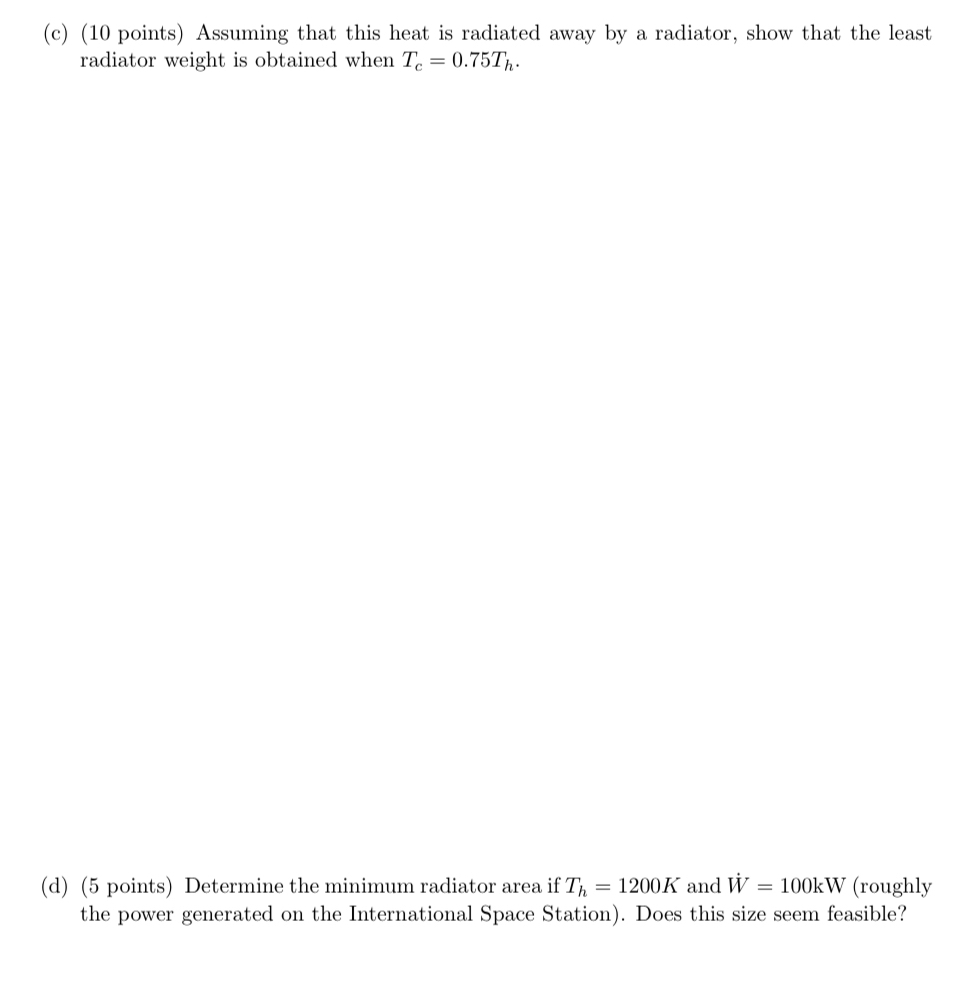
b pointsb For simplicity, let us assume that the engine is reversible. Express the heat rejected, in terms of and c points Assuming that this heat is radiated away by a radiator, show that the least radiator weight is obtained when
d points Determine the minimum radiator area if and roughly the power generated on the International Space Station Does this size seem feasible?
Step by Step Solution
There are 3 Steps involved in it
1 Expert Approved Answer
Step: 1 Unlock

Question Has Been Solved by an Expert!
Get step-by-step solutions from verified subject matter experts
Step: 2 Unlock
Step: 3 Unlock
 Study Help