







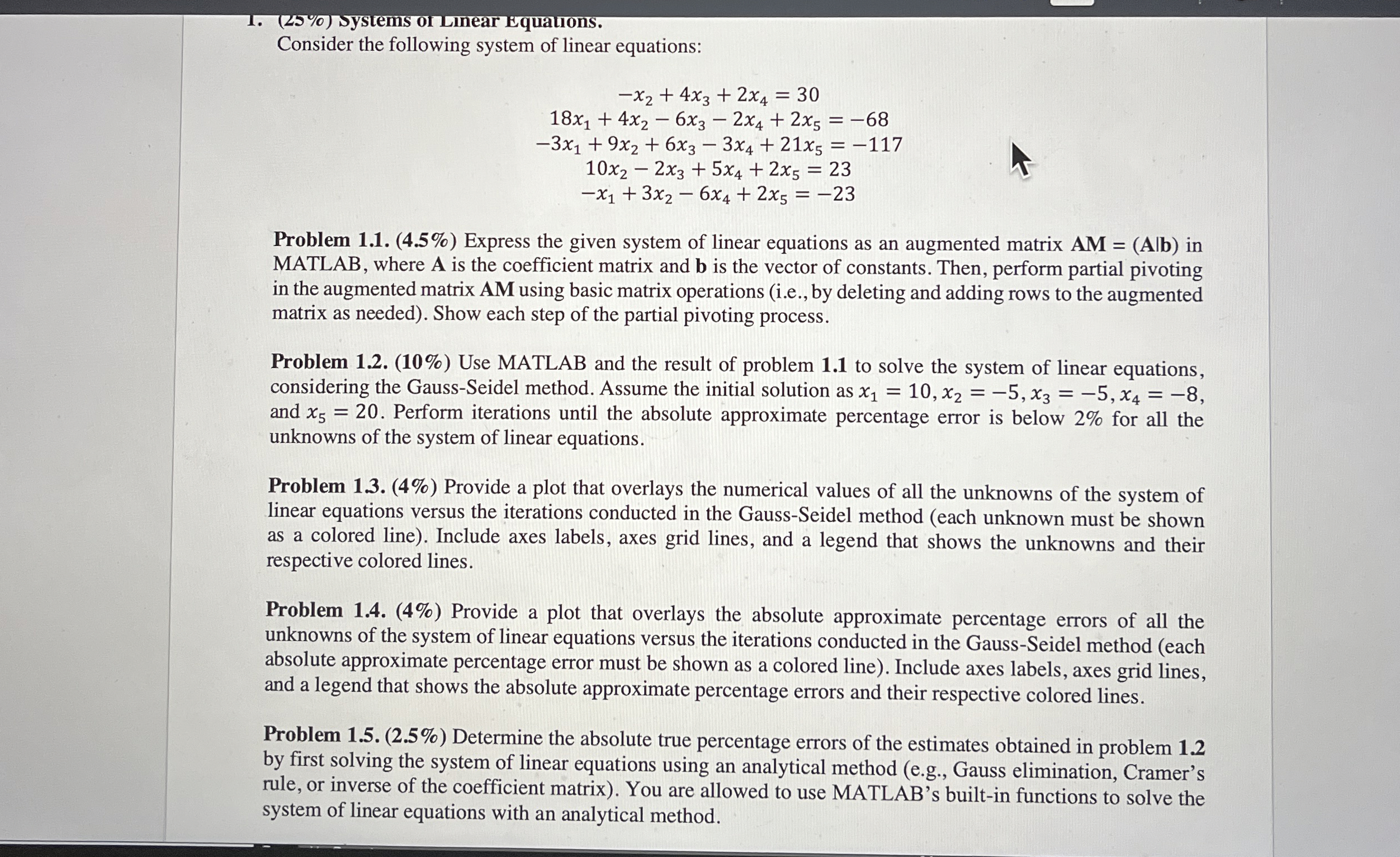
Question: ( 2 5 % ) Systems or Linear Equalions. Consider the following system of linear equations: - x 2 + 4 x 3 + 2
Systems or Linear Equalions.
Consider the following system of linear equations:
Problem Express the given system of linear equations as an augmented matrix in MATLAB, where is the coefficient matrix and is the vector of constants. Then, perform partial pivoting in the augmented matrix AM using basic matrix operations ie by deleting and adding rows to the augmented matrix as needed Show each step of the partial pivoting process.
Problem Use MATLAB and the result of problem to solve the system of linear equations, considering the GaussSeidel method. Assume the initial solution as and Perform iterations until the absolute approximate percentage error is below for all the unknowns of the system of linear equations.
Problem Provide a plot that overlays the numerical values of all the unknowns of the system of linear equations versus the iterations conducted in the GaussSeidel method each unknown must be shown as a colored line Include axes labels, axes grid lines, and a legend that shows the unknowns and their respective colored lines.
Problem Provide a plot that overlays the absolute approximate percentage errors of all the unknowns of the system of linear equations versus the iterations conducted in the GaussSeidel method each absolute approximate percentage error must be shown as a colored line Include axes labels, axes grid lines, and a legend that shows the absolute approximate percentage errors and their respective colored lines.
Problem Determine the absolute true percentage errors of the estimates obtained in problem by first solving the system of linear equations using an analytical method eg Gauss elimination, Cramer's rule, or inverse of the coefficient matrix You are allowed to use MATLAB's builtin functions to solve the system of linear equations with an analytical method.
Step by Step Solution
There are 3 Steps involved in it
1 Expert Approved Answer
Step: 1 Unlock

Question Has Been Solved by an Expert!
Get step-by-step solutions from verified subject matter experts
Step: 2 Unlock
Step: 3 Unlock
 Study Help