







Question: 2. [50 pts] Consider the function Vx - 1 (a) [4 pts] Find the domain of f. (b) [6 pts] Find the critical number(s) of
![2. [50 pts] Consider the function Vx - 1 (a) [4](https://s3.amazonaws.com/si.experts.images/answers/2024/06/666570e39a72f_067666570e381168.jpg)
![pts] Find the domain of f. (b) [6 pts] Find the critical](https://s3.amazonaws.com/si.experts.images/answers/2024/06/666570e3e3473_067666570e3c9b80.jpg)
![number(s) of f. (c) [6 pts] Find the intervals on which f](https://s3.amazonaws.com/si.experts.images/answers/2024/06/666570e430e47_068666570e4204c9.jpg)
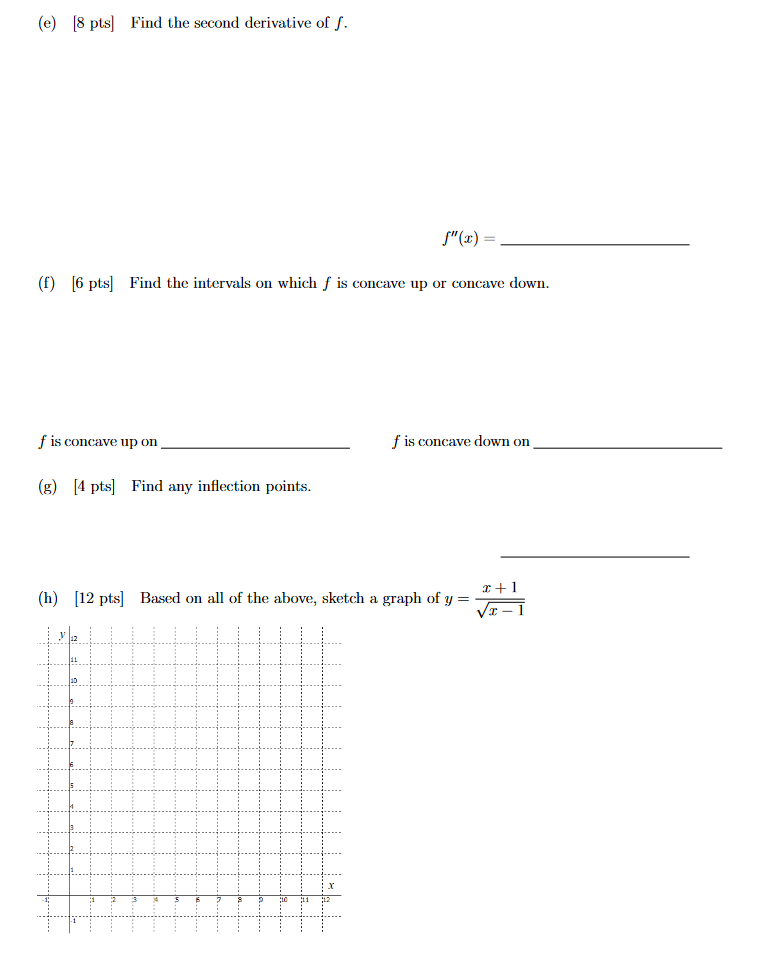
2. [50 pts] Consider the function Vx - 1 (a) [4 pts] Find the domain of f. (b) [6 pts] Find the critical number(s) of f. (c) [6 pts] Find the intervals on which f is increasing or decreasing. f is increasing on f is decreasing on (d) [4 pts] Find any local maximum or minimum points (I, ?). local maximum point(s) local minimum point(s)(e) [8 pts] Find the second derivative of S. f"(x) = (f) [6 pts] Find the intervals on which f is concave up or concave down. f is concave up on f is concave down on (g) [4 pts] Find any inflection points. (h) [12 pts] Based on all of the above, sketch a graph of y = VI - 1
Step by Step Solution
There are 3 Steps involved in it
1 Expert Approved Answer
Step: 1 Unlock

Question Has Been Solved by an Expert!
Get step-by-step solutions from verified subject matter experts
Step: 2 Unlock
Step: 3 Unlock
 Study Help