





Question: 2. (5+1+1+1+1+5) Continuing from question-1, a time study is initiated for inspection to be conducted on portable radios. The operation consists of seven elements: (1)
2. (5+1+1+1+1+5) Continuing from question-1, a
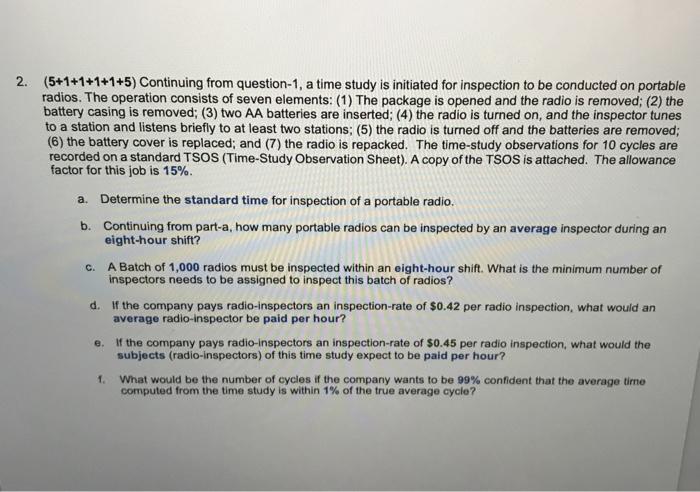
2. (5+1+1+1+1+5) Continuing from question-1, a time study is initiated for inspection to be conducted on portable radios. The operation consists of seven elements: (1) The package is opened and the radio is removed; (2) the battery casing is removed; (3) two AA batteries are inserted; (4) the radio is turned on, and the inspector tunes to a station and listens briefly to at least two stations; (5) the radio is turned off and the batteries are removed; (6) the battery cover is replaced; and (7) the radio is repacked. The time-study observations for 10 cycles are recorded on a standard TSOS (Time-Study Observation Sheet). A copy of the TSOS is attached. The allowance factor for this job is 15% a. Determine the standard time for inspection of a portable radio. b. Continuing from part-a, how many portable radios can be inspected by an average inspector during an eight-hour shift? c. A Batch of 1,000 radios must be inspected within an eight-hour shift. What is the minimum number of inspectors needs to be assigned to inspect this batch of radios? d. If the company pays radio-inspectors an inspection rate of $0.42 per radio inspection, what would an average radio-Inspector be paid per hour? e. If the company pays radio-Inspectors an inspection-rate of $0.45 per radio inspection, what would the subjects (radio-inspectors) of this time study expect to be paid per hour? What would be the number of cycles if the company wants to be 99% confident that the average time computed from the time study is within 1% of the true average cycle? 1 2. (5+1+1+1+1+5) Continuing from question-1, a time study is initiated for inspection to be conducted on portable radios. The operation consists of seven elements: (1) The package is opened and the radio is removed; (2) the battery casing is removed; (3) two AA batteries are inserted; (4) the radio is turned on, and the inspector tunes to a station and listens briefly to at least two stations; (5) the radio is turned off and the batteries are removed; (6) the battery cover is replaced; and (7) the radio is repacked. The time-study observations for 10 cycles are recorded on a standard TSOS (Time-Study Observation Sheet). A copy of the TSOS is attached. The allowance factor for this job is 15% a. Determine the standard time for inspection of a portable radio. b. Continuing from part-a, how many portable radios can be inspected by an average inspector during an eight-hour shift? c. A Batch of 1,000 radios must be inspected within an eight-hour shift. What is the minimum number of inspectors needs to be assigned to inspect this batch of radios? d. If the company pays radio-inspectors an inspection rate of $0.42 per radio inspection, what would an average radio-Inspector be paid per hour? e. If the company pays radio-Inspectors an inspection-rate of $0.45 per radio inspection, what would the subjects (radio-inspectors) of this time study expect to be paid per hour? What would be the number of cycles if the company wants to be 99% confident that the average time computed from the time study is within 1% of the true average cycle? 1

Step by Step Solution

There are 3 Steps involved in it

1 Expert Approved Answer
Step: 1 Unlock blur-text-image

Question Has Been Solved by an Expert!

Get step-by-step solutions from verified subject matter experts

Step: 2 Unlock
Step: 3 Unlock

Students Have Also Explored These Related General Management Questions!