







Question: 2. (6 points) The Pier Shellfish company processes and packages 2 types of shellfish to wholesale seafood distributors: shrimps and scallops. Both types go through
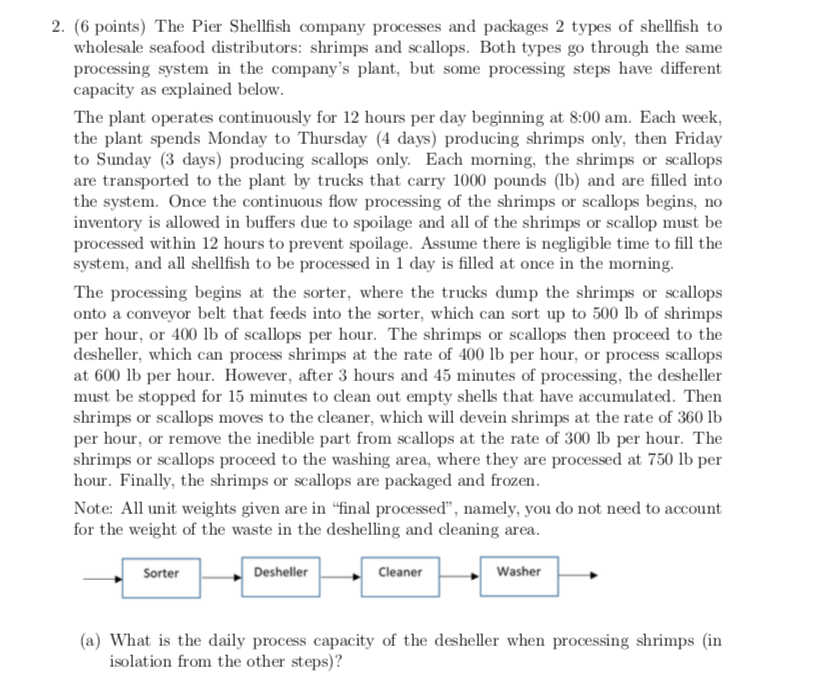
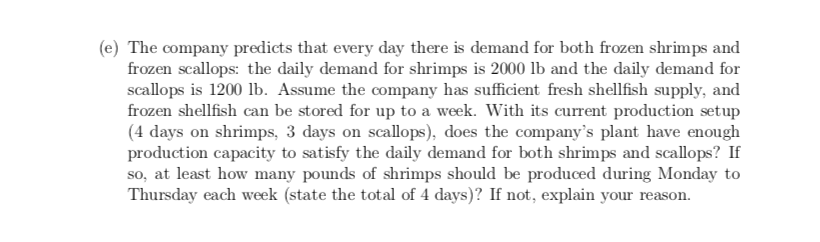
2. (6 points) The Pier Shellfish company processes and packages 2 types of shellfish to wholesale seafood distributors: shrimps and scallops. Both types go through the same processing system in the company's plant, but some processing steps have different capacity as explained below. The plant operates continuously for 12 hours per day beginning at 8:00 am. Each week, the plant spends Monday to Thursday (4 days) producing shrimps only, then Friday to Sunday (3 days) producing scallops only. Each morning, the shrimps or scallops are transported to the plant by trucks that carry 1000 pounds (lb) and are filled into the system. Once the continuous flow processing of the shrimps or scallops begins, no inventory is allowed in buffers due to spoilage and all of the shrimps or scallop must be processed within 12 hours to prevent spoilage. Assume there is negligible time to fill the system, and all shellfish to be processed in 1 day is filled at once in the morning. The processing begins at the sorter, where the trucks dump the shrimps or scallops onto a conveyor belt that feeds into the sorter, which can sort up to 500 lb of shrimps per hour, or 400 lb of scallops per hour. The shrimps or scallops then proceed to the desheller, which can process shrimps at the rate of 400 lb per hour, or process scallops at 600 lb per hour. However, after 3 hours and 45 minutes of processing, the desheller must be stopped for 15 minutes to clean out empty shells that have accumulated. Then shrimps or scallops moves to the cleaner, which will devein shrimps at the rate of 360 lb per hour, or remove the inedible part from scallops at the rate of 300 lb per hour. The shrimps or scallops proceed to the washing area, where they are processed at 750 lb per hour. Finally, the shrimps or scallops are packaged and frozen. Note: All unit weights given are in "final processed, namely, you do not need to account for the weight of the waste in the deshelling and cleaning area. Sorter Desheller Cleaner Washer (a) What is the daily process capacity of the desheller when processing shrimps (in isolation from the other steps)? (e) The company predicts that every day there is demand for both frozen shrimps and frozen scallops: the daily demand for shrimps is 2000 lb and the daily demand for scallops is 1200 lb. Assume the company has sufficient fresh shellfish supply, and frozen shellfish can be stored for up to a week. With its current production setup (4 days on shrimps, 3 days on scallops), does the company's plant have enough production capacity to satisfy the daily demand for both shrimps and scallops? If so, at least how many pounds of shrimps should be produced during Monday to Thursday each week (state the total of 4 days)? If not, explain your reason. 2. (6 points) The Pier Shellfish company processes and packages 2 types of shellfish to wholesale seafood distributors: shrimps and scallops. Both types go through the same processing system in the company's plant, but some processing steps have different capacity as explained below. The plant operates continuously for 12 hours per day beginning at 8:00 am. Each week, the plant spends Monday to Thursday (4 days) producing shrimps only, then Friday to Sunday (3 days) producing scallops only. Each morning, the shrimps or scallops are transported to the plant by trucks that carry 1000 pounds (lb) and are filled into the system. Once the continuous flow processing of the shrimps or scallops begins, no inventory is allowed in buffers due to spoilage and all of the shrimps or scallop must be processed within 12 hours to prevent spoilage. Assume there is negligible time to fill the system, and all shellfish to be processed in 1 day is filled at once in the morning. The processing begins at the sorter, where the trucks dump the shrimps or scallops onto a conveyor belt that feeds into the sorter, which can sort up to 500 lb of shrimps per hour, or 400 lb of scallops per hour. The shrimps or scallops then proceed to the desheller, which can process shrimps at the rate of 400 lb per hour, or process scallops at 600 lb per hour. However, after 3 hours and 45 minutes of processing, the desheller must be stopped for 15 minutes to clean out empty shells that have accumulated. Then shrimps or scallops moves to the cleaner, which will devein shrimps at the rate of 360 lb per hour, or remove the inedible part from scallops at the rate of 300 lb per hour. The shrimps or scallops proceed to the washing area, where they are processed at 750 lb per hour. Finally, the shrimps or scallops are packaged and frozen. Note: All unit weights given are in "final processed, namely, you do not need to account for the weight of the waste in the deshelling and cleaning area. Sorter Desheller Cleaner Washer (a) What is the daily process capacity of the desheller when processing shrimps (in isolation from the other steps)? (e) The company predicts that every day there is demand for both frozen shrimps and frozen scallops: the daily demand for shrimps is 2000 lb and the daily demand for scallops is 1200 lb. Assume the company has sufficient fresh shellfish supply, and frozen shellfish can be stored for up to a week. With its current production setup (4 days on shrimps, 3 days on scallops), does the company's plant have enough production capacity to satisfy the daily demand for both shrimps and scallops? If so, at least how many pounds of shrimps should be produced during Monday to Thursday each week (state the total of 4 days)? If not, explain your reason
Step by Step Solution
There are 3 Steps involved in it

Get step-by-step solutions from verified subject matter experts
 Study Help