







Question: 2 7 . The demand for tea is given by the demand function ( Q _ { d } = 1 2 0 -
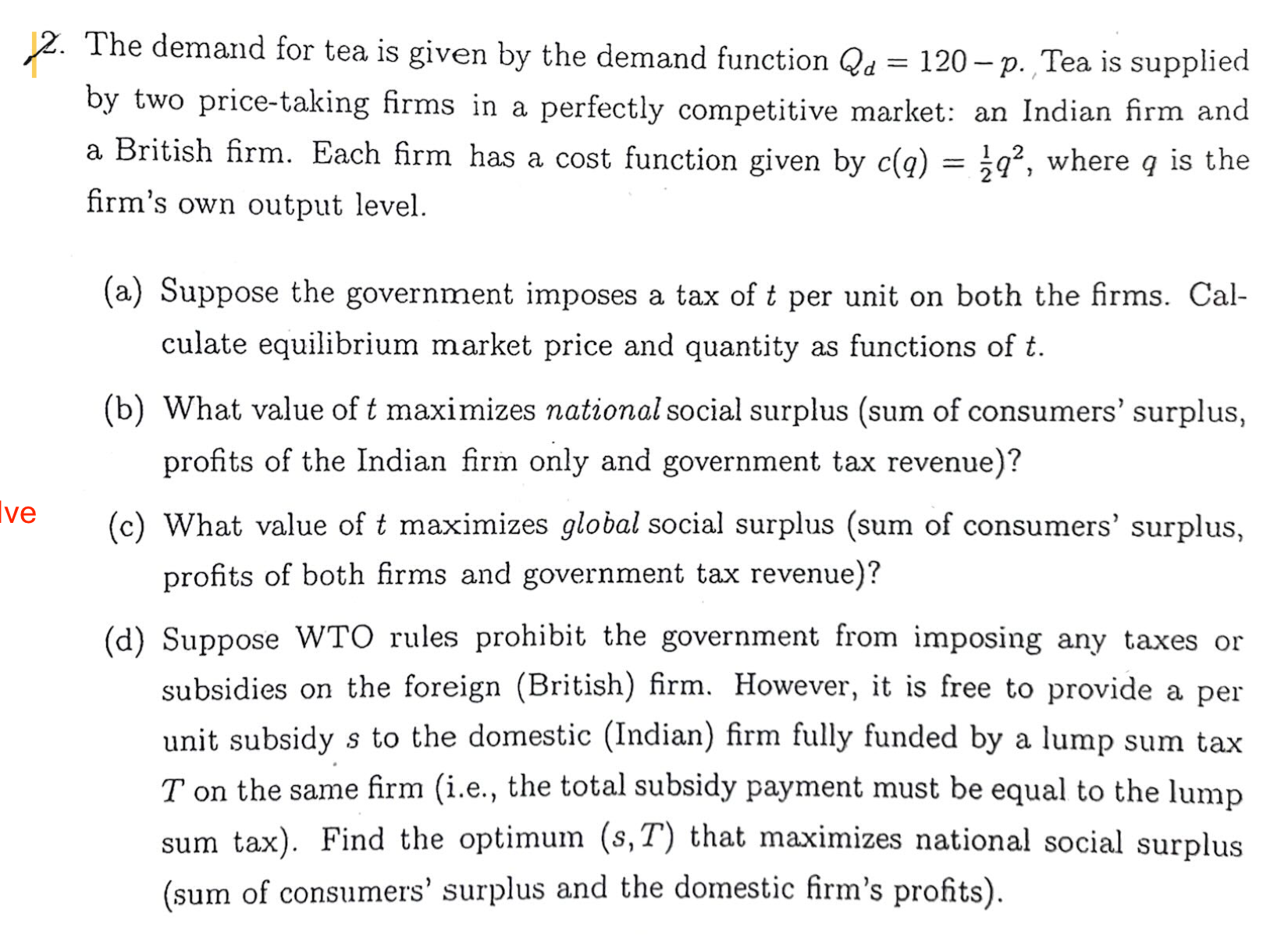
The demand for tea is given by the demand function Qdp Tea is supplied by two pricetaking firms in a perfectly competitive market: an Indian firm and a British firm. Each firm has a cost function given by cqfrac q where q is the firm's own output level.
a Suppose the government imposes a tax of t per unit on both the firms. Calculate equilibrium market price and quantity as functions of t
b What value of t maximizes national social surplus sum of consumers' surplus, profits of the Indian firm only and government tax revenue
c What value of t maximizes global social surplus sum of consumers' surplus, profits of both firms and government tax revenue
d Suppose WTO rules prohibit the government from imposing any taxes or subsidies on the foreign British firm. However, it is free to provide a per unit subsidy s to the domestic Indian firm fully funded by a lump sum tax T on the same firm ie the total subsidy payment must be equal to the lump sum tax Find the optimum s T that maximizes national social surplus sum of consumers' surplus and the domestic firm's profits
Step by Step Solution
There are 3 Steps involved in it
1 Expert Approved Answer
Step: 1 Unlock

Question Has Been Solved by an Expert!
Get step-by-step solutions from verified subject matter experts
Step: 2 Unlock
Step: 3 Unlock
 Study Help