







Question: 2. (8 points) Exercise 3.2. in textbook, (b) -(e): consider the Turing machine (for accepting strings of the form of w#w) whose description and state
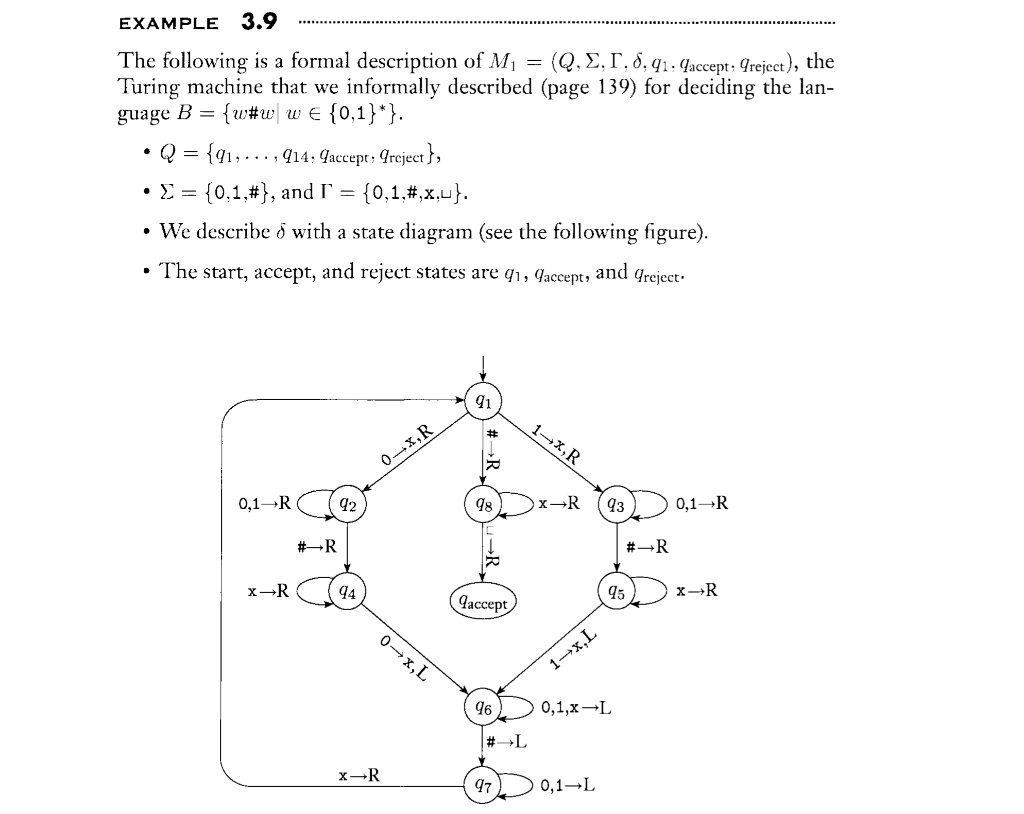
2. (8 points) Exercise 3.2. in textbook, (b) -(e): consider the Turing machine (for accepting strings of the form of w#w) whose description and state diagram appears in Example 3.9. Give the sequences of configurations that this machine enters when started on the input string: (a) (2 points) 1#1. (b) (2 points) 1##1. (c) (2 points) 10#11. (d) (2 points) 10#10. Recall that a Turing machine configuration is a 3-tuple consisting of (current state, tape content, tape head position), and can be abbreviated using the concatenation (tape before head) (state) (tape at and after head). An example of such a sequence of states can be found the textbook's solution to Exercise 3.2. (a). EXAMPLE 3.9 .......... The following is a formal description of M = (Q, 2,T. d, q1. qaccept: Greject), the Turing machine that we informally described (page 139) for deciding the lan- guage B = {u#w_w E {0,1}*}. Q = {q1,... , q14 qaccepr: Crejecr }, Y = {0,1,#}, and T = {0,1,#,x.}. We describe d with a state diagram {see the following figure). The start, accept, and reject states are q1, qaccept, and Greject- 1-X,R| 0-x,R 0,1-R( -R (43)) 0,1-R #-R K #-R x-R ( 65) x-R Haccept 0-x,L | - 1-x,L 46)) 0,1,x-L |#-L x- R 47)) 0,1-L
Step by Step Solution
There are 3 Steps involved in it

Get step-by-step solutions from verified subject matter experts
 Study Help