







Question: 2. (9.0 points) (a) Consider sampling students from the audience of a comedy show at UC Berkeley. The theater, which is currently at full capacity,
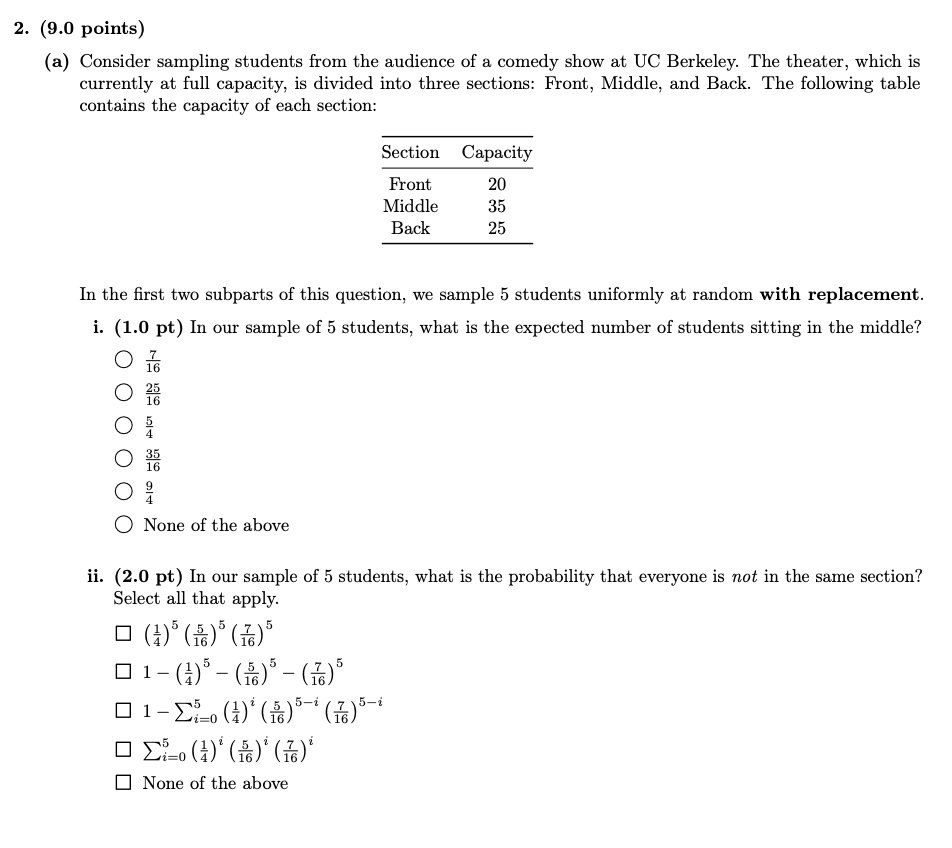
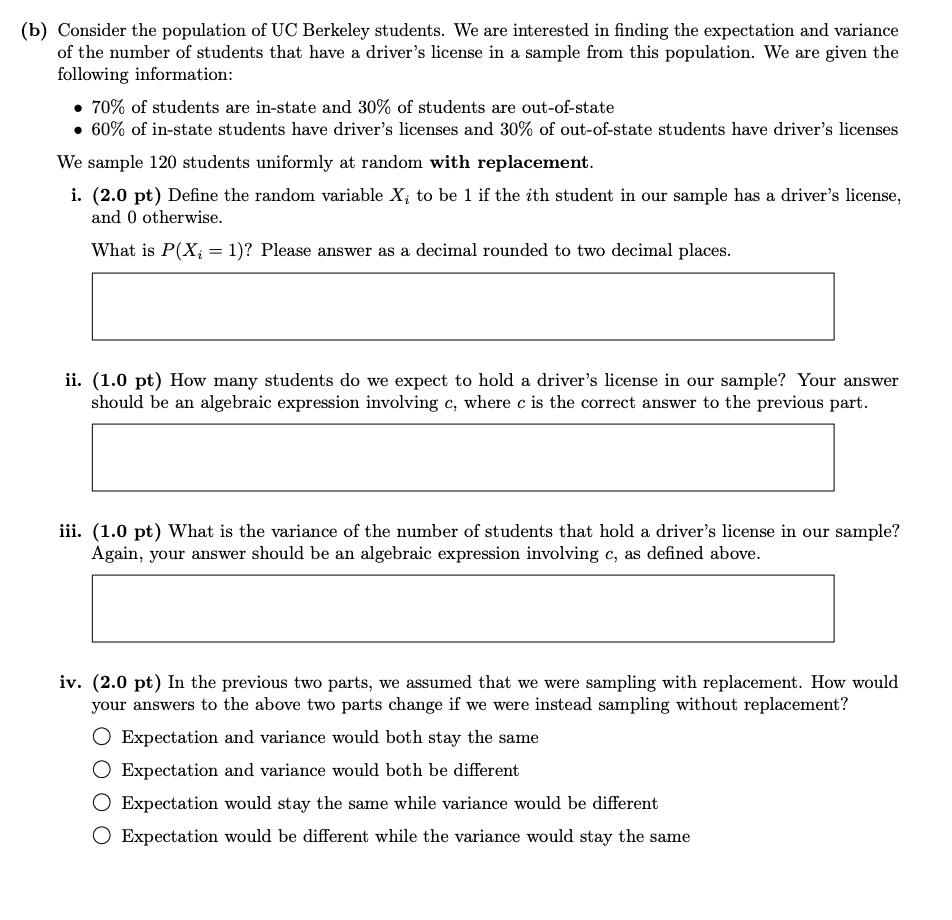
2. (9.0 points) (a) Consider sampling students from the audience of a comedy show at UC Berkeley. The theater, which is currently at full capacity, is divided into three sections: Front, Middle, and Back. The following table contains the capacity of each section: Section Capacity Front 20 Middle 35 Back 25 In the first two subparts of this question, we sample 5 students uniformly at random with replacement. i. (1.0 pt) In our sample of 5 students, what is the expected number of students sitting in the middle? O O 25 O O 35 O O None of the above ii. (2.0 pt) In our sample of 5 students, what is the probability that everyone is not in the same section? Select all that apply. O (4) ( PG) (76) 5 0 1- (1)' -(18) 5 - (16)5 01-2 ()'(16)5-'(76)5-2 O EL. (1)'(16)' (16) None of the above(b) Consider the population of UC Berkeley students. We are interested in finding the expectation and variance of the number of students that have a driver's license in a sample from this population. We are given the following information: . 70% of students are in-state and 30% of students are out-of-state . 60% of in-state students have driver's licenses and 30% of out-of-state students have driver's licenses We sample 120 students uniformly at random with replacement. i. (2.0 pt) Define the random variable X, to be 1 if the ith student in our sample has a driver's license, and 0 otherwise. What is P(X; = 1)? Please answer as a decimal rounded to two decimal places. ii. (1.0 pt) How many students do we expect to hold a driver's license in our sample? Your answer should be an algebraic expression involving c, where c is the correct answer to the previous part. iii. (1.0 pt) What is the variance of the number of students that hold a driver's license in our sample? Again, your answer should be an algebraic expression involving c, as defined above. iv. (2.0 pt) In the previous two parts, we assumed that we were sampling with replacement. How would your answers to the above two parts change if we were instead sampling without replacement? O Expectation and variance would both stay the same Expectation and variance would both be different O Expectation would stay the same while variance would be different O Expectation would be different while the variance would stay the same
Step by Step Solution
There are 3 Steps involved in it

Get step-by-step solutions from verified subject matter experts
 Study Help