







Question: 2. (a) A company assembles four products (A, B, C, and D). The profit per unit for each product (A, B, C, and D) is
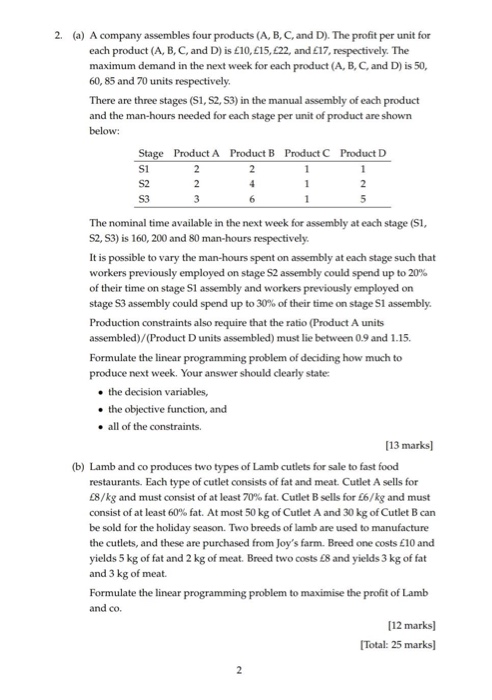
2. (a) A company assembles four products (A, B, C, and D). The profit per unit for each product (A, B, C, and D) is 10, 15, 22, and 17, respectively. The maximum demand in the next week for each product (A, B, C, and D) is 50, 60,85 and 70 units respectively. There are three stages (S1, S2, S3) in the manual assembly of each product and the man-hours needed for each stage per unit of product are shown below: Stage Product Product B Product C Product D The nominal time available in the next week for assembly at each stage (S1, S2, S3) is 160, 200 and 80 man-hours respectively. It is possible to vary the man-hours spent on assembly at each stage such that workers previously employed on stage S2 assembly could spend up to 20% of their time on stage Si assembly and workers previously employed on stage 53 assembly could spend up to 30% of their time on stage S1 assembly. Production constraints also require that the ratio (Product A units assembled)/(Product D units assembled) must lie between 0.9 and 1.15. Formulate the linear programming problem of deciding how much to produce next week. Your answer should clearly state: the decision variables, . the objective function, and all of the constraints. [13 marks] (b) Lamb and co produces two types of Lamb cutlets for sale to fast food restaurants. Each type of cutlet consists of fat and meat. Cutlet A sells for 8/kg and must consist of at least 70% fat. Cutlet B sells for 6/kg and must consist of at least 60% fat. At most 50 kg of Cutlet A and 30 kg of Cutlet B can be sold for the holiday season. Two breeds of lamb are used to manufacture the cutlets, and these are purchased from Joy's farm. Breed one costs 10 and yields 5 kg of fat and 2 kg of meat. Breed two costs 18 and yields 3 kg of fat and 3 kg of meat Formulate the linear programming problem to maximise the profit of Lamb and co. [12 marks] [Total: 25 marks) 2. (a) A company assembles four products (A, B, C, and D). The profit per unit for each product (A, B, C, and D) is 10, 15, 22, and 17, respectively. The maximum demand in the next week for each product (A, B, C, and D) is 50, 60,85 and 70 units respectively. There are three stages (S1, S2, S3) in the manual assembly of each product and the man-hours needed for each stage per unit of product are shown below: Stage Product Product B Product C Product D The nominal time available in the next week for assembly at each stage (S1, S2, S3) is 160, 200 and 80 man-hours respectively. It is possible to vary the man-hours spent on assembly at each stage such that workers previously employed on stage S2 assembly could spend up to 20% of their time on stage Si assembly and workers previously employed on stage 53 assembly could spend up to 30% of their time on stage S1 assembly. Production constraints also require that the ratio (Product A units assembled)/(Product D units assembled) must lie between 0.9 and 1.15. Formulate the linear programming problem of deciding how much to produce next week. Your answer should clearly state: the decision variables, . the objective function, and all of the constraints. [13 marks] (b) Lamb and co produces two types of Lamb cutlets for sale to fast food restaurants. Each type of cutlet consists of fat and meat. Cutlet A sells for 8/kg and must consist of at least 70% fat. Cutlet B sells for 6/kg and must consist of at least 60% fat. At most 50 kg of Cutlet A and 30 kg of Cutlet B can be sold for the holiday season. Two breeds of lamb are used to manufacture the cutlets, and these are purchased from Joy's farm. Breed one costs 10 and yields 5 kg of fat and 2 kg of meat. Breed two costs 18 and yields 3 kg of fat and 3 kg of meat Formulate the linear programming problem to maximise the profit of Lamb and co. [12 marks] [Total: 25 marks)
Step by Step Solution
There are 3 Steps involved in it

Get step-by-step solutions from verified subject matter experts
 Study Help