







Question: 2. (a). (b) An angle-modulated signal is given by x(t) = 4 sin (2106t + 60 sin 210+) (i) Find the instantaneous frequency of
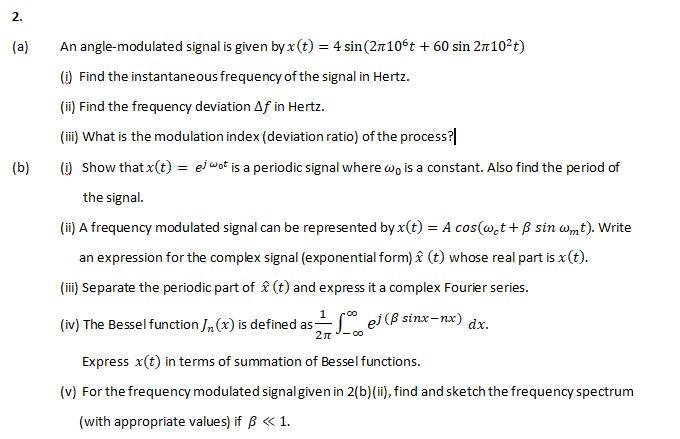
2. (a). (b) An angle-modulated signal is given by x(t) = 4 sin (2106t + 60 sin 210+) (i) Find the instantaneous frequency of the signal in Hertz. (ii) Find the frequency deviation Af in Hertz. (iii) What is the modulation index (deviation ratio) of the process? (i) Show that x(t) = ej wot is a periodic signal where wo is a constant. Also find the period of the signal. (ii) A frequency modulated signal can be represented by x(t) = A cos(wet + sin wmt). Write an expression for the complex signal (exponential form) (t) whose real part is x(t). (iii) Separate the periodic part of (t) and express it a complex Fourier series. 1 (iv) The Bessel function /(x) is defined as ej (B sinx-nx) dx. 2-co Express x(t) in terms of summation of Bessel functions. (v) For the frequency modulated signal given in 2(b)(ii), find and sketch the frequency spectrum (with appropriate values) if < 1.
Step by Step Solution
There are 3 Steps involved in it
i The instantaneous frequency of the signal is given by the derivative of the phase with respect to ... View full answer

Get step-by-step solutions from verified subject matter experts
 Study Help