







Question: 2 (a) Consider the following schema for a Library Database: BOOK (Book_id, Title, Publisher_Name, Pub_Year) BOOK_AUTHORS (Book_id, Author_Name) PUBLISHER (Name, Address, Phone) BOOK_COPIES (Book_id, Branch
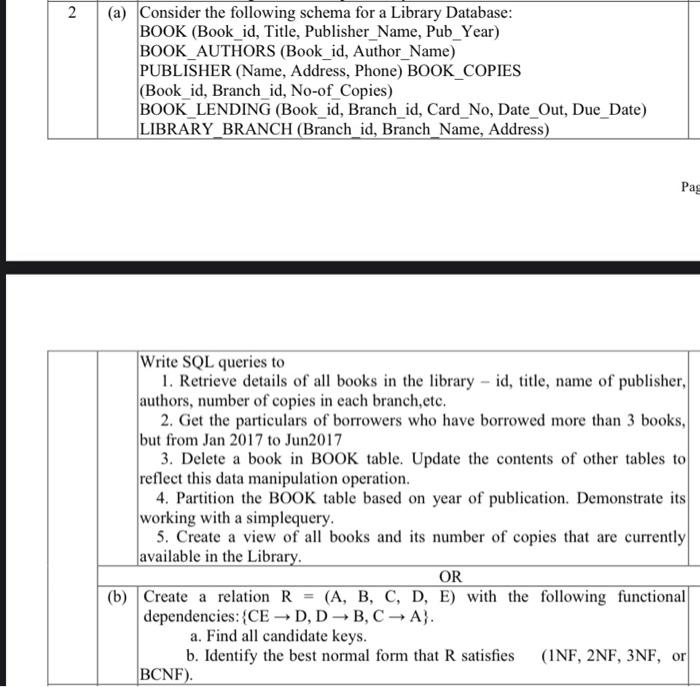
2 (a) Consider the following schema for a Library Database: BOOK (Book_id, Title, Publisher_Name, Pub_Year) BOOK_AUTHORS (Book_id, Author_Name) PUBLISHER (Name, Address, Phone) BOOK_COPIES (Book_id, Branch id, No-of Copies) BOOK LENDING (Book_id, Branch_id, Card_No, Date_Out, Due_Date) LIBRARY BRANCH (Branch_id, Branch Name, Address) Pag Write SQL queries to 1. Retrieve details of all books in the library - id, title, name of publisher, authors, number of copies in each branch,etc. 2. Get the particulars of borrowers who have borrowed more than 3 books, but from Jan 2017 to Jun2017 3. Delete a book in BOOK table. Update the contents of other tables to reflect this data manipulation operation. 4. Partition the BOOK table based on year of publication. Demonstrate its working with a simplequery. 5. Create a view of all books and its number of copies that are currently available in the Library. OR (b) Create a relation R = (A, B, C, D, E) with the following functional dependencies: {CED,D B, C A}. a. Find all candidate keys. b. Identify the best normal form that R satisfies (INF, 2NF, 3NF, or BCNF)
Step by Step Solution
There are 3 Steps involved in it

Get step-by-step solutions from verified subject matter experts
 Study Help