







Question: 2. A function f is left-continuous at a point x = c if lim_f(x) = f(c), and right continuous at x = c if
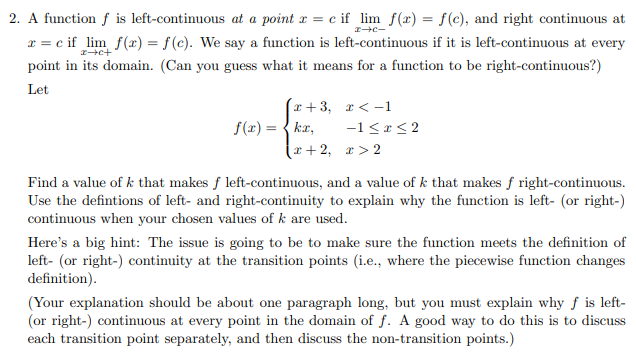
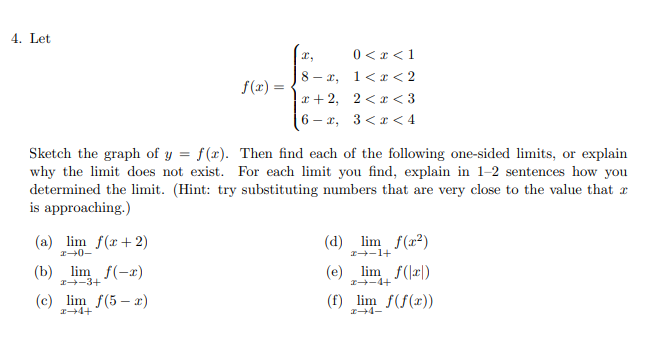
2. A function f is left-continuous at a point x = c if lim_f(x) = f(c), and right continuous at x = c if _lim_ f(x) = f(c). We say a function is left-continuous if it is left-continuous at every point in its domain. (Can you guess what it means for a function to be right-continuous?) Let -342 x+3, x < -1 f(x) = kx, -1x2 x+2, x>2 Find a value of k that makes f left-continuous, and a value of k that makes f right-continuous. Use the definitions of left and right-continuity to explain why the function is left- (or right-) continuous when your chosen values of k are used. Here's a big hint: The issue is going to be to make sure the function meets the definition of left- (or right-) continuity at the transition points (i.e., where the piecewise function changes definition). (Your explanation should be about one paragraph long, but you must explain why f is left- (or right-) continuous at every point in the domain of f. A good way to do this is to discuss each transition point separately, and then discuss the non-transition points.) 4. Let (a) lim f(x+2) Sketch the graph of y = f(x). Then find each of the following one-sided limits, or explain why the limit does not exist. For each limit you find, explain in 1-2 sentences how you determined the limit. (Hint: try substituting numbers that are very close to the value that is approaching.) -0+ (b) lim f(-x) x-3+ f(x) = (c) lim f(5-x) x+4+ 0 < x < 1 8-x, 1
Step by Step Solution
3.37 Rating (147 Votes )
There are 3 Steps involved in it

Get step-by-step solutions from verified subject matter experts
 Study Help