







Question: 2. A market is characterized by a demand function Q = 1 - P and by a single firm that has no production costs. The
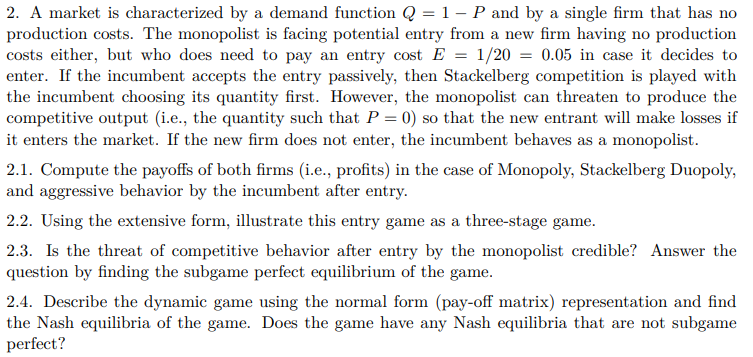
2. A market is characterized by a demand function Q = 1 - P and by a single firm that has no production costs. The monopolist is facing potential entry from a new firm having no production costs either, but who does need to pay an entry cost E = 1/20 = 0.05 in case it decides to enter. If the incumbent accepts the entry passively, then Stackelberg competition is played with the incumbent choosing its quantity first. However, the monopolist can threaten to produce the competitive output (i.e., the quantity such that P = 0) so that the new entrant will make losses if it enters the market. If the new firm does not enter, the incumbent behaves as a monopolist. 2.1. Compute the payoffs of both firms (i.e., profits) in the case of Monopoly, Stackelberg Duopoly, and aggressive behavior by the incumbent after entry. 2.2. Using the extensive form, illustrate this entry game as a three-stage game. 2.3. Is the threat of competitive behavior after entry by the monopolist credible? Answer the question by finding the subgame perfect equilibrium of the game. 2.4. Describe the dynamic game using the normal form (pay-off matrix) representation and find the Nash equilibria of the game. Does the game have any Nash equilibria that are not subgame perfect? 2. A market is characterized by a demand function Q = 1 - P and by a single firm that has no production costs. The monopolist is facing potential entry from a new firm having no production costs either, but who does need to pay an entry cost E = 1/20 = 0.05 in case it decides to enter. If the incumbent accepts the entry passively, then Stackelberg competition is played with the incumbent choosing its quantity first. However, the monopolist can threaten to produce the competitive output (i.e., the quantity such that P = 0) so that the new entrant will make losses if it enters the market. If the new firm does not enter, the incumbent behaves as a monopolist. 2.1. Compute the payoffs of both firms (i.e., profits) in the case of Monopoly, Stackelberg Duopoly, and aggressive behavior by the incumbent after entry. 2.2. Using the extensive form, illustrate this entry game as a three-stage game. 2.3. Is the threat of competitive behavior after entry by the monopolist credible? Answer the question by finding the subgame perfect equilibrium of the game. 2.4. Describe the dynamic game using the normal form (pay-off matrix) representation and find the Nash equilibria of the game. Does the game have any Nash equilibria that are not subgame perfect
Step by Step Solution
There are 3 Steps involved in it

Get step-by-step solutions from verified subject matter experts
 Study Help