



Question: 2 . A rocket is designed to travel in a CONSTANT ACCELERATION trajectory, instead of the constant thrust trajectory that we considered in class. Therefore,
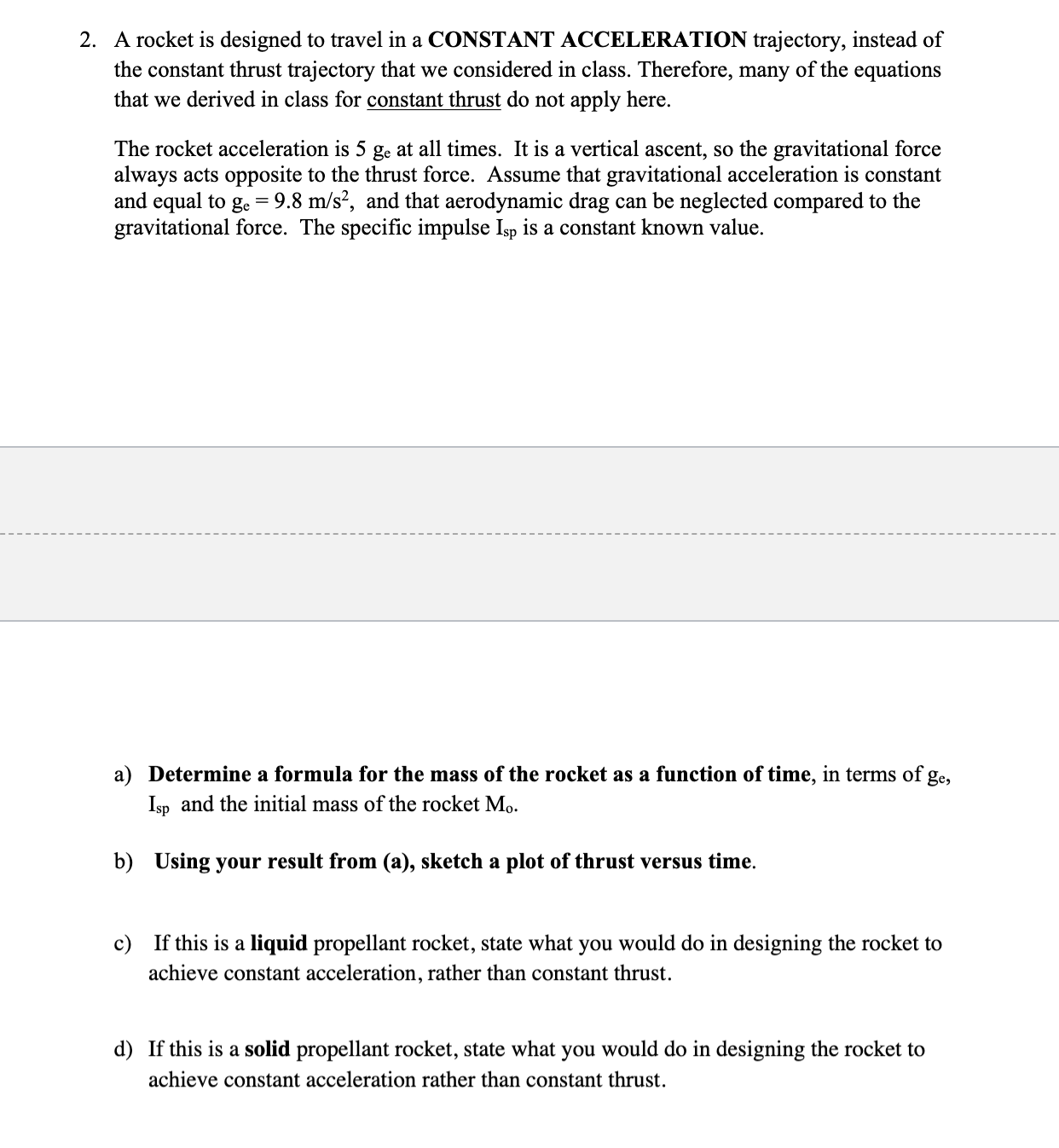
A rocket is designed to travel in a CONSTANT ACCELERATION trajectory, instead of the constant thrust trajectory that we considered in class. Therefore, many of the equations that we derived in class for constant thrust do not apply here.
The rocket acceleration is ge at all times. It is a vertical ascent, so the gravitational force always acts opposite to the thrust force. Assume that gravitational acceleration is constant and equal to mathrmgmathrmemathrm~mmathrms and that aerodynamic drag can be neglected compared to the gravitational force. The specific impulse Is p is a constant known value.
a Determine a formula for the mass of the rocket as a function of time, in terms of mathrmgmathrme Itext sp and the initial mass of the rocket mathrmM
b Using your result from a sketch a plot of thrust versus time.
c If this is a liquid propellant rocket, state what you would do in designing the rocket to achieve constant acceleration, rather than constant thrust.
d If this is a solid propellant rocket, state what you would do in designing the rocket to achieve constant acceleration rather than constant thrust.
Step by Step Solution
There are 3 Steps involved in it
1 Expert Approved Answer
Step: 1 Unlock

Question Has Been Solved by an Expert!
Get step-by-step solutions from verified subject matter experts
Step: 2 Unlock
Step: 3 Unlock