



Question: 2. A Static Universe and Einstein's Greatest Blunder(?) Once Einstein invented General Relativity, he went on in 1917 to apply this theory to a

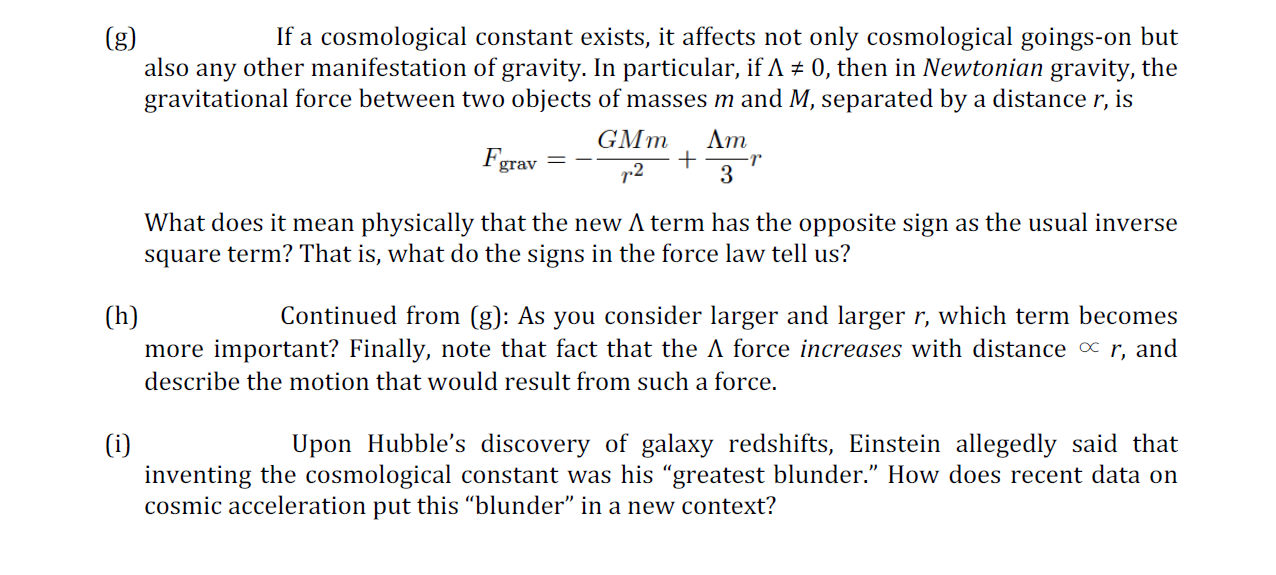
2. A Static Universe and Einstein's Greatest Blunder(?) Once Einstein invented General Relativity, he went on in 1917 to apply this theory to a homogeneous and isotropic universe (as he correctly guessed it ought to be, inventing the cosmological principle along the way). To his surprise and dismay, he found that General Relativity demands that the universe is dynamic. That is, Einstein's theory demands that the universe either expands or contracts, and forbids a "static" universe in which galaxies are (on average) at rest relative to each other. (g) If a cosmological constant exists, it affects not only cosmological goings-on but also any other manifestation of gravity. In particular, if 0, then in Newtonian gravity, the gravitational force between two objects of masses m and M, separated by a distance r, is Am + - 3 Fgrav (i) = GMm p2 What does it mean physically that the new A term has the opposite sign as the usual inverse square term? That is, what do the signs in the force law tell us? (h) Continued from (g): As you consider larger and larger r, which term becomes more important? Finally, note that fact that the A force increases with distance r, and describe the motion that would result from such a force. Upon Hubble's discovery of galaxy redshifts, Einstein allegedly said that inventing the cosmological constant was his "greatest blunder." How does recent data on cosmic acceleration put this "blunder" in a new context?
Step by Step Solution
3.39 Rating (149 Votes )
There are 3 Steps involved in it
g The opposite sign of the A term means that the force of gravity is repulsive instead of attractive ... View full answer

Get step-by-step solutions from verified subject matter experts