







Question: 2. a. What is the atomic mass unit (@) and how is it defined? b. Which of the following have an atomic mass near 1
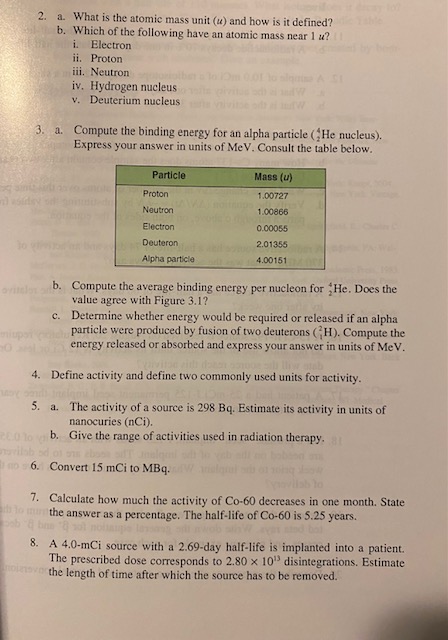
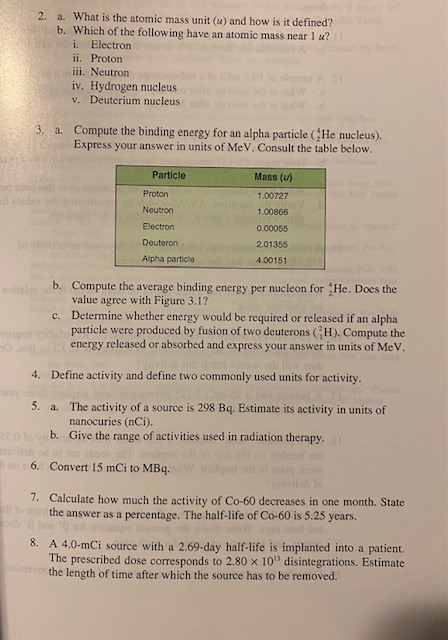
2. a. What is the atomic mass unit (@) and how is it defined? b. Which of the following have an atomic mass near 1 &? ! i. Electron ii. Proton iii. Neutron iv. Hydrogen nucleus v. Deuterium nucleus 3. a. Compute the binding energy for an alpha particle ( ; He nucleus). Express your answer in units of Me V. Consult the table below. Particle Mass (u) Proton 1.00727 Neutron 1.00866 Election 0.00055 Doutoron 2.01355 Alpha particle 4.00151 b. Compute the average binding energy per nucleon for ;He. Does the value agree with Figure 3.17 c. Determine whether energy would be required or released if an alpha particle were produced by fusion of two deuterons ( H). Compute the energy released or absorbed and express your answer in units of MeV. 4. Define activity and define two commonly used units for activity. 5. a. The activity of a source is 298 Bq. Estimate its activity in units of nanocuries (nCi). 260 10 b. Give the range of activities used in radiation therapy. Tavilab ed of sun no = 6. Convert 15 mCi to MBq. rialgrul art 7. Calculate how much the activity of Co-60 decreases in one month. State I do thi the answer as a percentage. The half-life of Co-60 is 5.25 years. 5ob -8 ban 8. A 4.0-mCi source with a 2.69-day half-life is implanted into a patient. The prescribed dose corresponds to 2.80 x 10" disintegrations. Estimate tokensv the length of time after which the source has to be removed
Step by Step Solution
There are 3 Steps involved in it

Get step-by-step solutions from verified subject matter experts
 Study Help