







Question: 2. According to the Change Detection CogLab global data which are based on a population of 45,108 participants - the mean proportion of correct responses
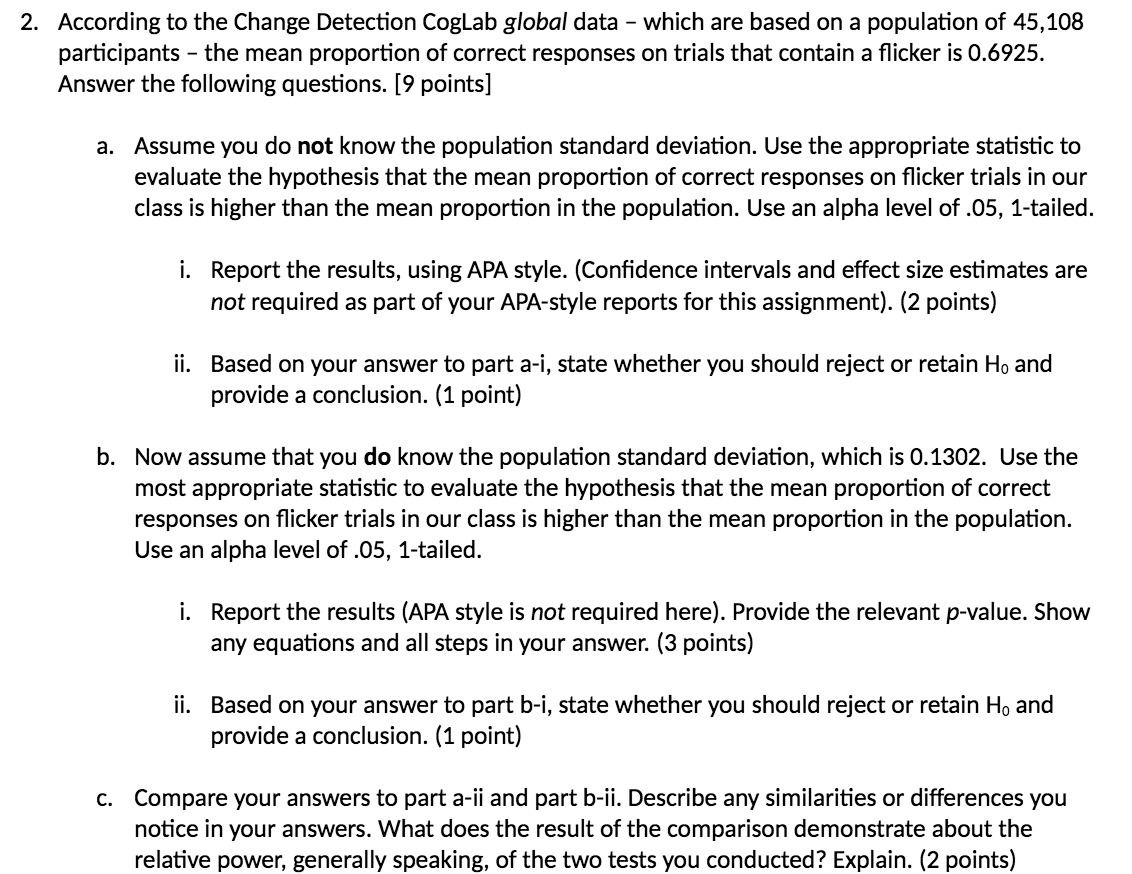
2. According to the Change Detection CogLab global data which are based on a population of 45,108 participants - the mean proportion of correct responses on trials that contain a icker is 0.6925. Answer the following questions. [9 points] a. Assume you do not know the population standard deviation. Use the appropriate statistic to evaluate the hypothesis that the mean proportion of correct responses on icker trials in our class is higher than the mean proportion in the population. Use an alpha level of .05, 1-tailed. i. Report the results, using APA style. (Condence intervals and effect size estimates are not required as part of your APA-style reports for this assignment). (2 points) ii. Based on your answer to part a-i, state whether you should reject or retain Ho and provide a conclusion. (1 point) b. Now assume that you do know the population standard deviation, which is 0.1302. Use the most appropriate statistic to evaluate the hypothesis that the mean proportion of correct responses on icker trials in our class is higher than the mean proportion in the population. Use an alpha level of .05, 1-tailed. i. Report the results (APA style is not required here). Provide the relevant pvalue. Show any equations and all steps in your answer. (3 points) ii. Based on your answer to part b-i, state whether you should reject or retain Ho and provide a conclusion. (1 point) c. Compare your answers to part a-ii and part b-ii. Describe any similarities or differences you notice in your answers. What does the result of the comparison demonstrate about the relative power, generally speaking, of the two tests you conducted? Explain. (2 points)
Step by Step Solution
There are 3 Steps involved in it

Get step-by-step solutions from verified subject matter experts
 Study Help