







Question: 2. As the first sub-step of the QR algorithm for A, we used an orthogonal matrix Q1 to reduce the first column ay to a
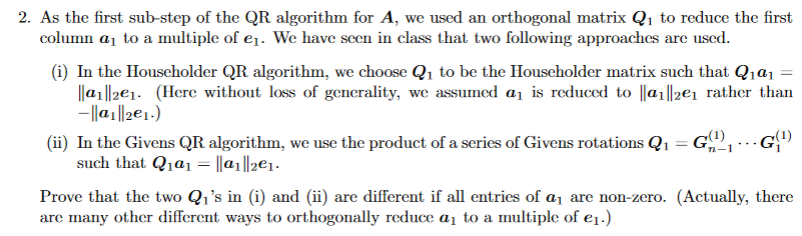
2. As the first sub-step of the QR algorithm for A, we used an orthogonal matrix Q1 to reduce the first column ay to a multiple of ej. We have seen in class that two following approaches are used. (i) In the Householder QR algorithm, we choose Q1 to be the Householder matrix such that Qia = ||21||21. (Here without loss of generality, we assumed ay is reduced to ||01||2rather than -||a1||201.) (ii) In the Givens QR algorithm, we use the product of a series of Givens rotations Q =G22 GA? ..G{) such that Qiai = ||01||201. Prove that the two Qi's in (i) and (ii) are different if all entries of a, are non-zero. (Actually, there are many other different ways to orthogonally reduce aj to a multiple of e1.) 2. As the first sub-step of the QR algorithm for A, we used an orthogonal matrix Q1 to reduce the first column ay to a multiple of ej. We have seen in class that two following approaches are used. (i) In the Householder QR algorithm, we choose Q1 to be the Householder matrix such that Qia = ||21||21. (Here without loss of generality, we assumed ay is reduced to ||01||2rather than -||a1||201.) (ii) In the Givens QR algorithm, we use the product of a series of Givens rotations Q =G22 GA? ..G{) such that Qiai = ||01||201. Prove that the two Qi's in (i) and (ii) are different if all entries of a, are non-zero. (Actually, there are many other different ways to orthogonally reduce aj to a multiple of e1.)
Step by Step Solution
There are 3 Steps involved in it

Get step-by-step solutions from verified subject matter experts
 Study Help