







Question: 2. Asset Pricing Consider a sequential model in which consumers do not directly own physical capital, but are the owners of the representative firm and,
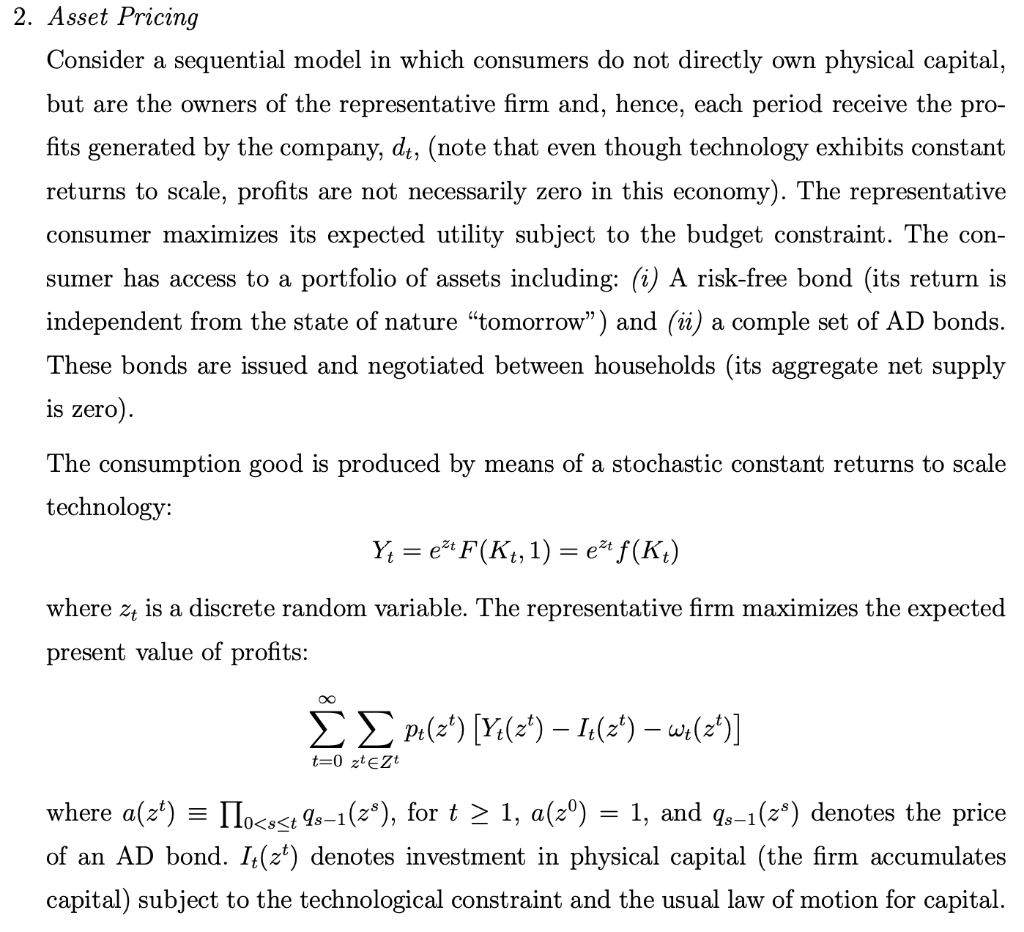

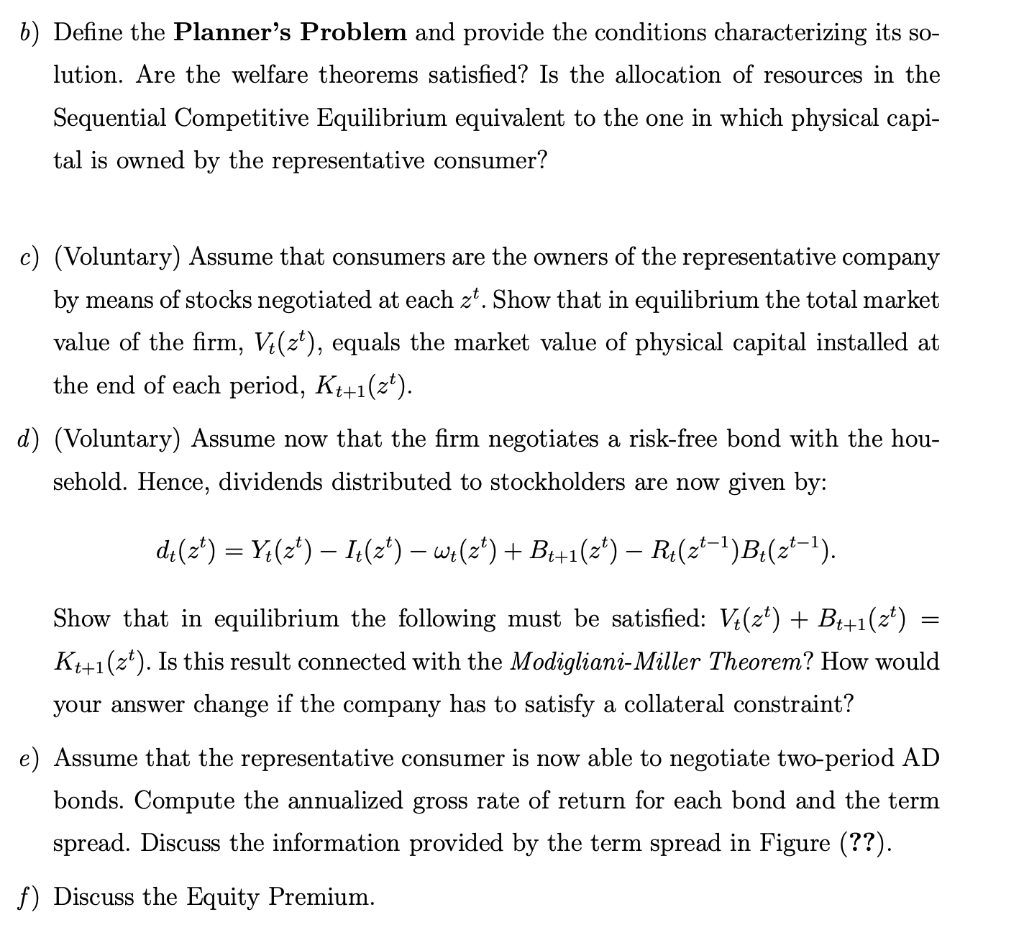
2. Asset Pricing Consider a sequential model in which consumers do not directly own physical capital, but are the owners of the representative firm and, hence, each period receive the pro- fits generated by the company, dt, (note that even though technology exhibits constant returns to scale, profits are not necessarily zero in this economy). The representative consumer maximizes its expected utility subject to the budget constraint. The con- sumer has access to a portfolio of assets including: (i) A risk-free bond (its return is independent from the state of nature tomorrow) and (ii) a comple set of AD bonds. These bonds are issued and negotiated between households (its aggregate net supply is zero). The consumption good is produced by means of a stochastic constant returns to scale technology: Y+ = extF(Kt, 1) = ezt f(Kt) where Zt is a discrete random variable. The representative firm maximizes the expected present value of profits: CEP(z) [Y/(z) It(z) We(z)] t=0 zt ezt = = where a(z) = Ilocost 9s_1(z), for t > 1, a(z) 1, and qs-1(28) denotes the price of an AD bond. It(z) denotes investment in physical capital (the firm accumulates capital) subject to the technological constraint and the usual law of motion for capital. a) Define a Sequential Equilibrium for this economy and find the conditions cha- racterizing it. What is the equilibrium price of each bond? What is the relation between the price of the risk-free bond and the AD bonds? b) Define the Planner's Problem and provide the conditions characterizing its so- lution. Are the welfare theorems satisfied? Is the allocation of resources in the Sequential Competitive Equilibrium equivalent to the one in which physical capi- tal is owned by the representative consumer? c) (Voluntary) Assume that consumers are the owners of the representative company by means of stocks negotiated at each z. Show that in equilibrium the total market value of the firm, V+(2+), equals the market value of physical capital installed at the end of each period, Kt+1(z+). d) (Voluntary) Assume now that the firm negotiates a risk-free bond with the hou- sehold. Hence, dividends distributed to stockholders are now given by: -1 dt(z+) = Y/(z) 14(z) - wr(z) + B++1(z+) R4(zt-1)B+(2k-1). = Show that in equilibrium the following must be satisfied: V+(2+) + Bt+1(2+) Kt+1(z). Is this result connected with the Modigliani-Miller Theorem? How would your answer change if the company has to satisfy a collateral constraint? e) Assume that the representative consumer is now able to negotiate two-period AD bonds. Compute the annualized gross rate of return for each bond and the term spread. Discuss the information provided by the term spread in Figure (??). f) Discuss the Equity Premium. 2. Asset Pricing Consider a sequential model in which consumers do not directly own physical capital, but are the owners of the representative firm and, hence, each period receive the pro- fits generated by the company, dt, (note that even though technology exhibits constant returns to scale, profits are not necessarily zero in this economy). The representative consumer maximizes its expected utility subject to the budget constraint. The con- sumer has access to a portfolio of assets including: (i) A risk-free bond (its return is independent from the state of nature tomorrow) and (ii) a comple set of AD bonds. These bonds are issued and negotiated between households (its aggregate net supply is zero). The consumption good is produced by means of a stochastic constant returns to scale technology: Y+ = extF(Kt, 1) = ezt f(Kt) where Zt is a discrete random variable. The representative firm maximizes the expected present value of profits: CEP(z) [Y/(z) It(z) We(z)] t=0 zt ezt = = where a(z) = Ilocost 9s_1(z), for t > 1, a(z) 1, and qs-1(28) denotes the price of an AD bond. It(z) denotes investment in physical capital (the firm accumulates capital) subject to the technological constraint and the usual law of motion for capital. a) Define a Sequential Equilibrium for this economy and find the conditions cha- racterizing it. What is the equilibrium price of each bond? What is the relation between the price of the risk-free bond and the AD bonds? b) Define the Planner's Problem and provide the conditions characterizing its so- lution. Are the welfare theorems satisfied? Is the allocation of resources in the Sequential Competitive Equilibrium equivalent to the one in which physical capi- tal is owned by the representative consumer? c) (Voluntary) Assume that consumers are the owners of the representative company by means of stocks negotiated at each z. Show that in equilibrium the total market value of the firm, V+(2+), equals the market value of physical capital installed at the end of each period, Kt+1(z+). d) (Voluntary) Assume now that the firm negotiates a risk-free bond with the hou- sehold. Hence, dividends distributed to stockholders are now given by: -1 dt(z+) = Y/(z) 14(z) - wr(z) + B++1(z+) R4(zt-1)B+(2k-1). = Show that in equilibrium the following must be satisfied: V+(2+) + Bt+1(2+) Kt+1(z). Is this result connected with the Modigliani-Miller Theorem? How would your answer change if the company has to satisfy a collateral constraint? e) Assume that the representative consumer is now able to negotiate two-period AD bonds. Compute the annualized gross rate of return for each bond and the term spread. Discuss the information provided by the term spread in Figure (??). f) Discuss the Equity Premium
Step by Step Solution
There are 3 Steps involved in it

Get step-by-step solutions from verified subject matter experts
 Study Help