



Question: 2. Assume the following representation for a floating point number I sign bit, 4 bits exponent, 4 bits for the significand, and a bias of
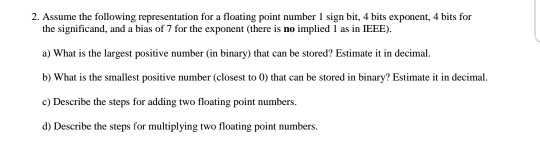
2. Assume the following representation for a floating point number I sign bit, 4 bits exponent, 4 bits for the significand, and a bias of 7 for the exponent (there is no implied 1 as in IEEE) a) What is the largest positive number (in binary) that can be stored? Estimate it in decimal. b) What is the smallest positive number (closest to 0) that can be stored in binary? Estimate it in decimal. c Describe the steps for adding two floating point numbers. d) Describe the steps for multiplying two floating point numbers
Step by Step Solution
There are 3 Steps involved in it
1 Expert Approved Answer
Step: 1 Unlock

Question Has Been Solved by an Expert!
Get step-by-step solutions from verified subject matter experts
Step: 2 Unlock
Step: 3 Unlock