







Question: 2. Atmospheric pressures The basic barometer can be used to measure air pressure changes with elevation, such as from the base of a mountain to
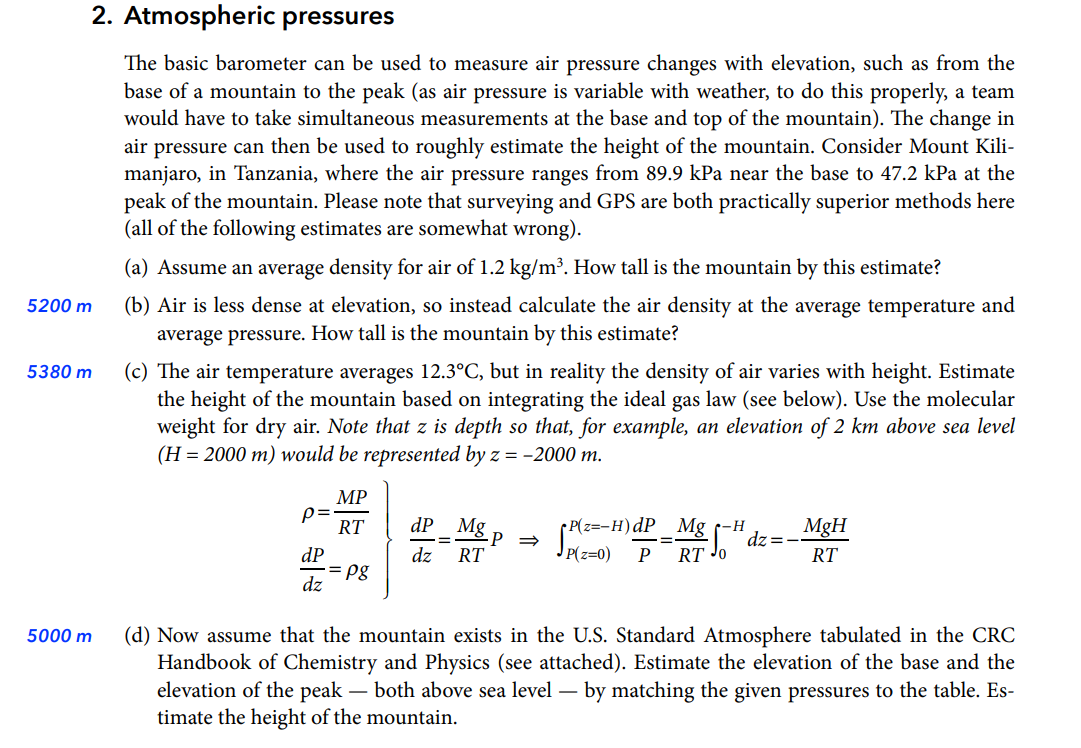
2. Atmospheric pressures The basic barometer can be used to measure air pressure changes with elevation, such as from the base of a mountain to the peak (as air pressure is variable with weather, to do this properly, a team would have to take simultaneous measurements at the base and top of the mountain). The change in air pressure can then be used to roughly estimate the height of the mountain. Consider Mount Kilimanjaro, in Tanzania, where the air pressure ranges from 89.9kPa near the base to 47.2kPa at the peak of the mountain. Please note that surveying and GPS are both practically superior methods here (all of the following estimates are somewhat wrong). (a) Assume an average density for air of 1.2kg/m3. How tall is the mountain by this estimate? (b) Air is less dense at elevation, so instead calculate the air density at the average temperature and average pressure. How tall is the mountain by this estimate? (c) The air temperature averages 12.3C, but in reality the density of air varies with height. Estimate the height of the mountain based on integrating the ideal gas law (see below). Use the molecular weight for dry air. Note that z is depth so that, for example, an elevation of 2km above sea level (H=2000m) would be represented by z=2000m. =RTMPdzdP=g}dzdP=RTMgPP(z=0)P(z=H)PdP=RTMg0Hdz=RTMgH (d) Now assume that the mountain exists in the U.S. Standard Atmosphere tabulated in the CRC Handbook of Chemistry and Physics (see attached). Estimate the elevation of the base and the elevation of the peak - both above sea level - by matching the given pressures to the table. Estimate the height of the mountain
Step by Step Solution
There are 3 Steps involved in it

Get step-by-step solutions from verified subject matter experts
 Study Help