







Question: 2 . Calculate the shift ( i . e . breathing motion ) between the first 1 - dimensional signal ( which we call the
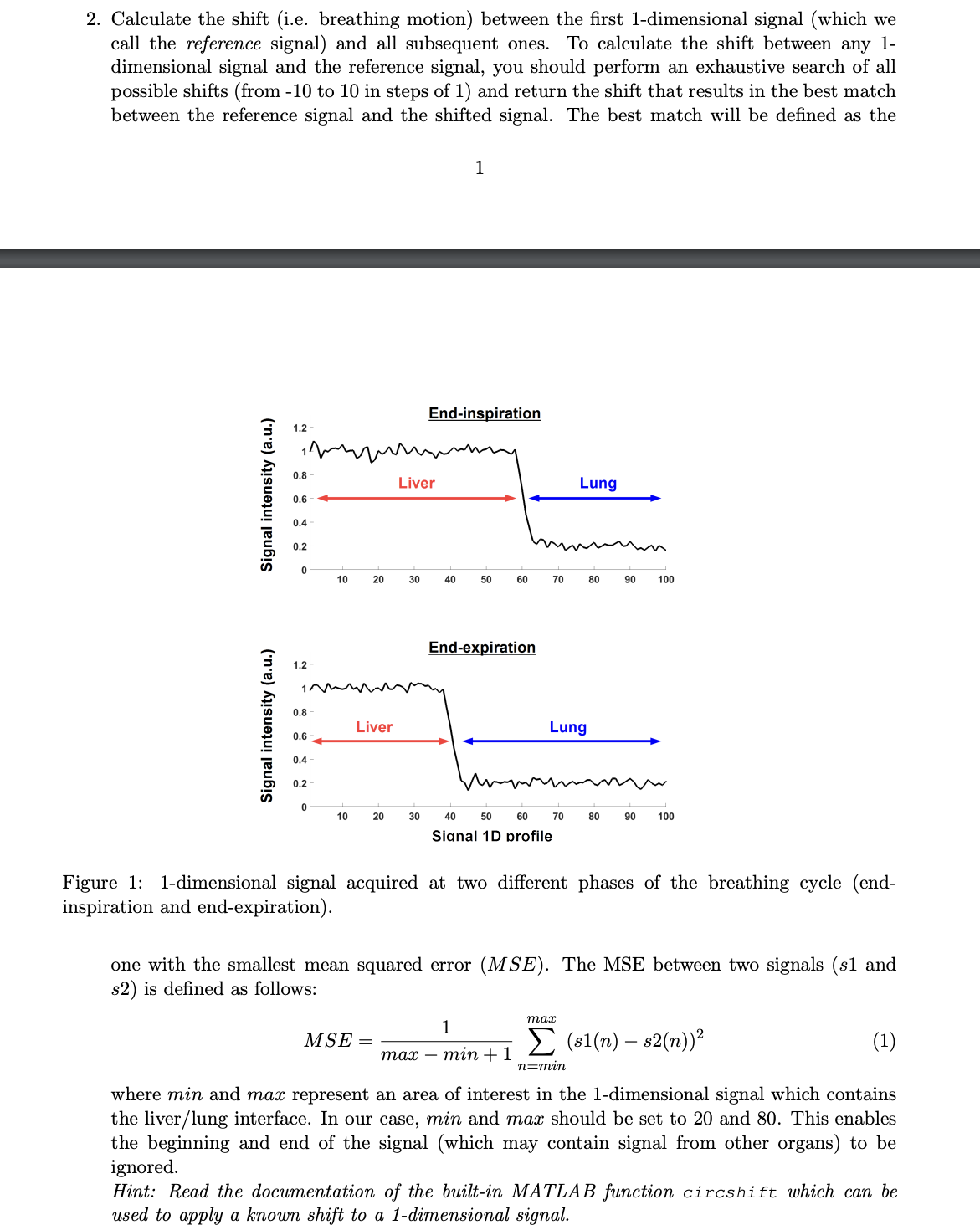
Calculate the shift ie breathing motion between the first dimensional signal which we call the reference signal and all subsequent ones. To calculate the shift between any dimensional signal and the reference signal, you should perform an exhaustive search of all possible shifts from to in steps of and return the shift that results in the best match between the reference signal and the shifted signal. The best match will be defined as the
Sianal D profile
Figure : dimensional signal acquired at two different phases of the breathing cycle endinspiration and endexpiration
one with the smallest mean squared error M S E The MSE between two signals s and s is defined as follows:
M S Efracmax min sumnmin max s ns n
where min and max represent an area of interest in the dimensional signal which contains the liverlung interface. In our case, min and max should be set to and This enables the beginning and end of the signal which may contain signal from other organs to be ignored.
Hint: Read the documentation of the builtin MATLAB function circshift which can be used to apply a known shift to a dimensional signal.
Step by Step Solution
There are 3 Steps involved in it
1 Expert Approved Answer
Step: 1 Unlock

Question Has Been Solved by an Expert!
Get step-by-step solutions from verified subject matter experts
Step: 2 Unlock
Step: 3 Unlock
 Study Help