







Question: 2. Carbonyl groups can react with hydrazine, NH2NH2 (Wolff Kishner reaction). Why then is the dinitrophenyl derivative of hydrazine used for this test instead of

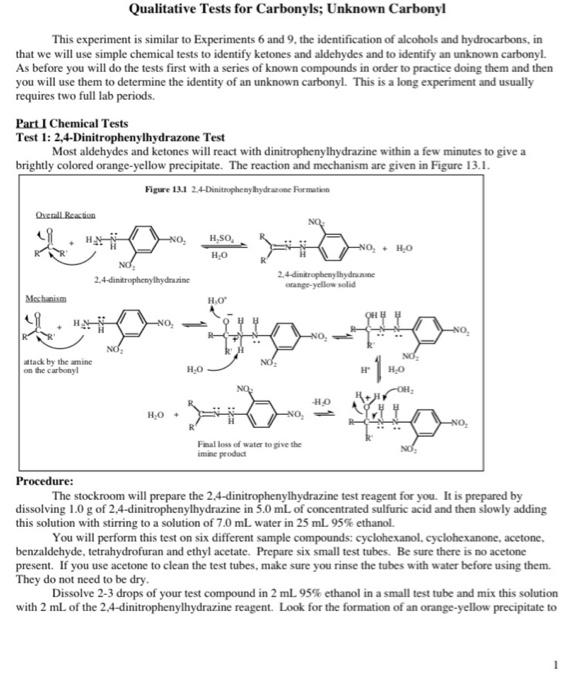
2. Carbonyl groups can react with hydrazine, NH2NH2 (Wolff Kishner reaction). Why then is the dinitrophenyl derivative of hydrazine used for this test instead of using hydrazine?? (1 pt) 3. To make Tollen's reagent, first sodium hydroxide solution is added to silver nitrate solution. A Qualitative Tests for Carbonyls: Unknown Carbonyl This experiment is similar to Experiments 6 and 9, the identification of alcohols and hydrocarbons, in that we will use simple chemical tests to identify ketones and aldehydes and to identify an unknown carbonyl. As before you will do the tests first with a series of known compounds in order to practice doing them and then you will use them to determine the identity of an unknown carbonyl. This is a long experiment and usually requires two full lab periods. Part I Chemical Tests Test 1: 2,4-Dinitrophenylhydrazone Test Most aldehydes and ketones will react with dinitrophenylhydrazine within a few minutes to give a brightly colored orange-yellow precipitate. The reaction and mechanism are given in Figure 13.1. Figure 13.1 2.4-Dimitrophenylhydrasone Formation Oxcall Reaction -NO, H.SO HO NO HO Nd 2.4-dinaraphenylhydrazine 2.4 dmitrophenylhyde range-yellow solid Mechanism H.O NO, Theo nd 1 na pin NO attack by the aminc on the carbonyl H.O HO HO NO Follow of water to give the imine product Procedure: The stockroom will prepare the 2.4-dinitrophenylhydrazine test reagent for you. It is prepared by dissolving 1.0 g of 2.4-dinitrophenylhydrazine in 5.0 mL of concentrated sulfuric acid and then slowly adding this solution with stirring to a solution of 7.0 mL water in 25 mL 95% ethanol You will perform this test on six different sample compounds: cyclohexanol, cyclohexanone, acetone, benzaldehyde, tetrahydrofuran and ethyl acetate. Prepare six small test tubes. Be sure there is no acetone present. If you use acetone to clean the test tubes, make sure you rinse the tubes with water before using them. They do not need to be dry. Dissolve 2-3 drops of your test compound in 2 mL 95% ethanol in a small test tube and mix this solution with 2 ml of the 2,4-dinitrophenylhydrazine reagent. Look for the formation of an orange-yellow precipitate to
Step by Step Solution
There are 3 Steps involved in it

Get step-by-step solutions from verified subject matter experts
 Study Help