



Question: 2. CASE STUDY INDIVIDUAL INSTRUCTION - Answer ALL questions AD Auto operated a second-hand imported car dealership for a major Japanese distributor. AD Auto's owner,
2. CASE STUDY INDIVIDUAL
INSTRUCTION - Answer ALL questions
AD Auto operated a second-hand imported car dealership for a major Japanese distributor. AD
Auto's owner, Mr. Adam Daniel, attributed much of the business's success to its no-frills policy of
competitive pricing and immediate cash payment. The business was basically a simple one - the firm
imported these second-hand cars at the beginning of each quarter and paid the Japanese distributor
at the end of each quarter. The revenues from the sale of these cars covered the payment to the
distributor and the expenses of running the business, as well as providing Mr. Adam with a good
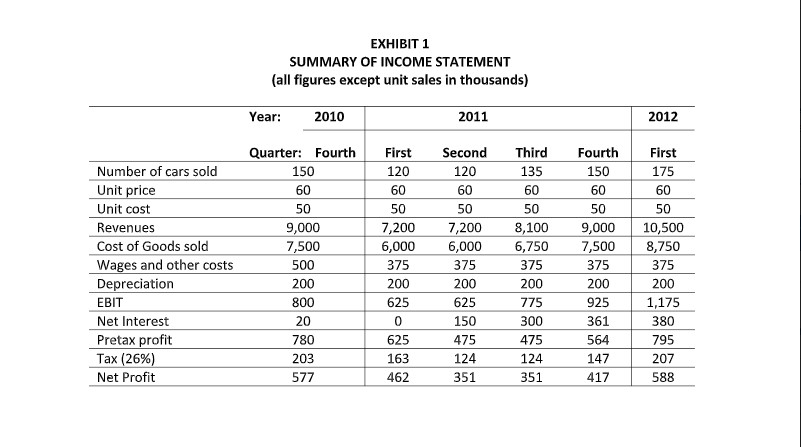
return on his equity investment. By the fourth quarter of 2010, sales were running at 150 cars a
quarter. Since average sale price of each car was about RM60,000, this translated into quarterly
revenues of 150 x RM60,000 = RM9 million. The average cost of each imported car was RM500,000.
After paying wages, rent, and other recurring costs of RM50,000 per quarter and deducting
depreciation of RM200,000, the company was left with earnings before interest and taxes (EBIT) of
RM800,000 a quarter and net profits of RM577,000.
This year 2011 was not a happy year for car importers in the country. The new automotive
policy had led to a general decline in auto sales, while the fall in the value of ringgit to Japanese Yen
shaved profit margins for many dealers in Japanese imported cars. AD Auto, more than most firms,
foresaw the difficulties ahead and reacted at once by offering 6 months' free credit while holding
the sale price of its cars constant. Wages and other costs were cut by 25 percent to RM375,000 a
quarter and the company effectively eliminated capital expenditures. This rearrangement appeared
successful. Even though unit sales fell by 20 percent to 120 units a quarter, the company continued
to operate in a satisfactory profit (see Exhibit 1).
The decline in sales lasted for 6 months, but as consumer confidence began to return, auto
sales began to recover. The company's new policy of 6 months' free credit was proving sufficiently
popular that Mr. Adam decided to maintain the policy. In the third quarter of 2011, sales had
recovered to 135 units; by the fourth quarter they were back to 150 units; and by the first quarter of
2012, they had reached 175 units. It looked as if by the second quarter of 2012 that company could
expect to sell 200 cars. Earnings before interest and tax (EBIT) were already in excess of their
previous high and Mr. Adam was able to congratulate himself on weathering what looked to be a
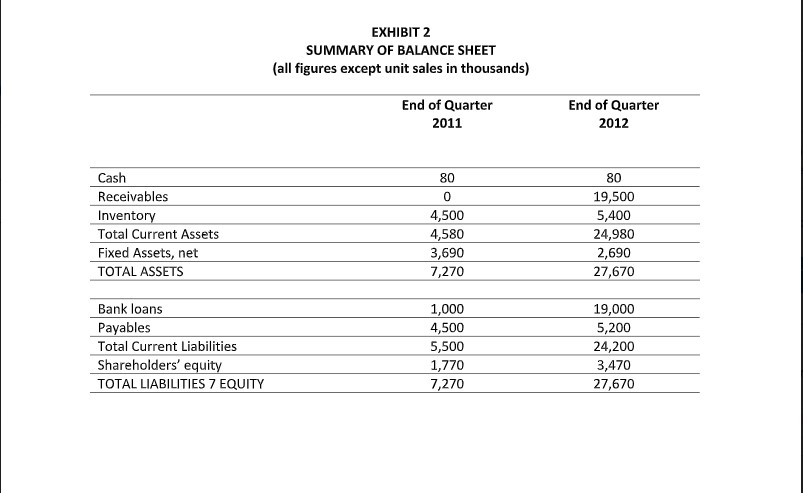
tricky period. Over the last 12-month period, AD Auto had earned a net profits of over RM1.7
million, and the equity had grown from just under RM2 million to about RM3.4 million.
Mr. Adam Daniel was first and foremost a superb salesman and always left the financial
aspects of the business to his financial manager. However, there was one feature of the financial
statements that disturbed Adam - the mounting level of debt, which by the end of the first quarter
of 2012 had reached RM19 million. This unease turned to alarm when the financial manager phoned
to say that the bank was reluctant to extend further credit and was even questioning its current level
of risk exposure to the company.
Adam found it impossible to understand how such successful year could have landed the
company in financial difficulties. The company had always had good relationships with its bank, and
the interest rate on its bank loans was a reasonable 8 percent a year (or about 2 percent a quarter).
Surely, Adam reasoned, when the bank saw the projected sales growth for the rest of 2012, it would
realize that there were plenty of profits to enable to start repaying its loans.
Step by Step Solution
There are 3 Steps involved in it

Get step-by-step solutions from verified subject matter experts