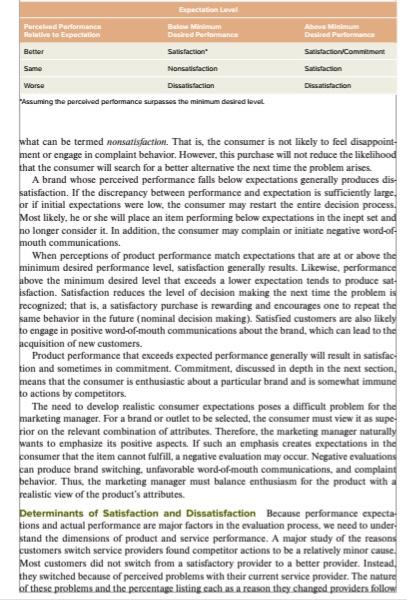
Question: 2. Chapter 18 discusses the evaluation processes consumers undertake for judging brands. Using the Expectations. Performance, and Satisfaction Framework presented in Table 18-1 on p.
2. Chapter 18 discusses the evaluation processes consumers undertake for judging brands. Using the Expectations. Performance, and Satisfaction Framework presented in Table 18-1 on p. 651 and video lecture for chapter 18, make TWO recommendations to Macy's to get highest possible consumer satisfaction for the shopBeacon technology. (Maximum One Page 10 Points) Del Pas Expection Le Purch Performance Balm Relative to Expectation Denied Pecine Better Satisfaction Same Nonsatisfaction Worce Dissatisfaction Assuming the perceived performance surpasses the minimum desired laval Satisation Commitment Satisfaction Dissatisfaction what can be termed nonsatisfaction. That is the consumer is not likely to feel disappoint- ment or engage in complaint behavior. However, this purchase will not reduce the likelihood that the consumer will search for a better alternative the next time the problem arises A brand whose perceived performance falls below expectations generally produces dis- satisfaction. If the discrepancy between performance and expectation is sufficiently large, or if initial expectations were low, the consumer may restart the entire decision process. Most likely, he or she will place an item performing below expectations in the inept set and no longer consider it. In addition, the consumer may complain or initiate negative word-of- mouth communications. When perceptions of product performance match expectations that are at or above the minimum desired performance level, satisfaction generally results. Likewise, performance above the minimum desired level that exceeds a lower expectation tends to produce sat- isfaction. Satisfaction reduces the level of decision making the next time the problem is recognized that is, a satisfactory purchase is rewarding and encourages one to repeat the same behavior in the future (nominal decision making). Satisfied customers are also likely to engage in positive word-of-mouth communications about the brand, which can lead to the acquisition of new customers. Product performance that exceeds expected performance generally will result in satisfac tion and sometimes in commitment. Commitment, discussed in depth in the next section, means that the consumer is enthusiastic about a particular brand and is somewhat immund to actions by competitors. The need to develop realistic consumer expectations poses a difficult problem for the marketing manager. For a brand or outlet to be selected, the consumer must view it as supe rior on the relevant combination of attributes. Therefore, the marketing manager naturally wants to emphasize its positive aspects. If such an emphasis creates expectations in the consumer that the item cannot fulfill, a negative evaluation may occur. Negative evaluation can produce brand switching, unfavorable word-of-mouth communications, and complaint behavior. Thus, the marketing manager must balance enthusiasm for the product with a realistic view of the product's attributes Determinants of Satisfaction and Dissatisfaction Because performance expecta tions and actual performance are major factors in the evaluation process, we need to under stand the dimensions of product and service performance. A major study of the reasons customers switch service providers found competitor actions to be a relatively minor cause. Most customers did not switch from a satisfactory provider to a better provider. Instead, they switched because of perceived problems with their current service provider. The nature of these problems and the percentage listing cuch as a reason they changed providers follow










 Study Help