



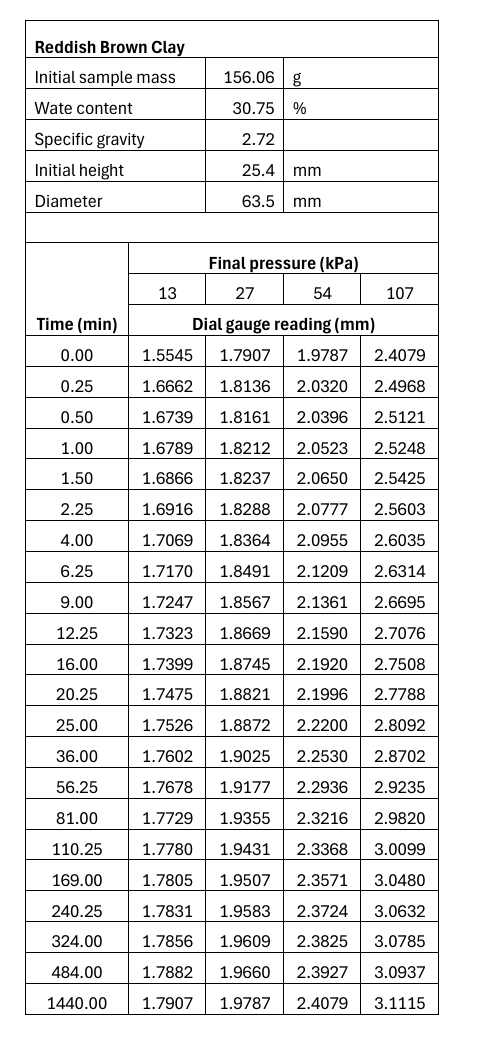
Question: 2 . Coefficient of Volume Change mv . For each of the four pressure increments compute the coefficient of volume chang ( kPa - 1
Coefficient of Volume Change mv
For each of the four pressure increments compute the coefficient of volume chang kPa and coefficient of permeability msec
Void ratio Log pressure plot
Calculate the void ratio at the start of the first test, and at the completion of primary
consolidation for each load increment, then plot these void ratios against the logarithm base of the applied pressure. From this plot estimate
i Compression Index Cc
ii Recompression Index Cr
iii. Preconsolidation pressure
iv Over Consolidation Ratio of the insitu soil. Discuss your results.
Extended questions:
A site containing a similar reddishbrown clay is being investigated for development. It consists of a m thick sand layer dry density kgm which overlays the silty clay layer m thick
The bottom of the clay is marked by an impermeable rock. Water table was found to be at m from the ground surface. If a proposed structure on the site is expected to apply a surcharge of kPa, what would be the ultimate primary consolidation settlement?
State your assumptions. Comment on your answer and discuss the geotechnical solutions available.
Please provide a detailed answer with clear equations and answers. thanks. PLease answer all.
Step by Step Solution
There are 3 Steps involved in it
1 Expert Approved Answer
Step: 1 Unlock

Question Has Been Solved by an Expert!
Get step-by-step solutions from verified subject matter experts
Step: 2 Unlock
Step: 3 Unlock