







Question: 2 . - Comparing elastic solutions to other expressions obtained using other common engineering theories can provide valuable insight as to the limitations of the
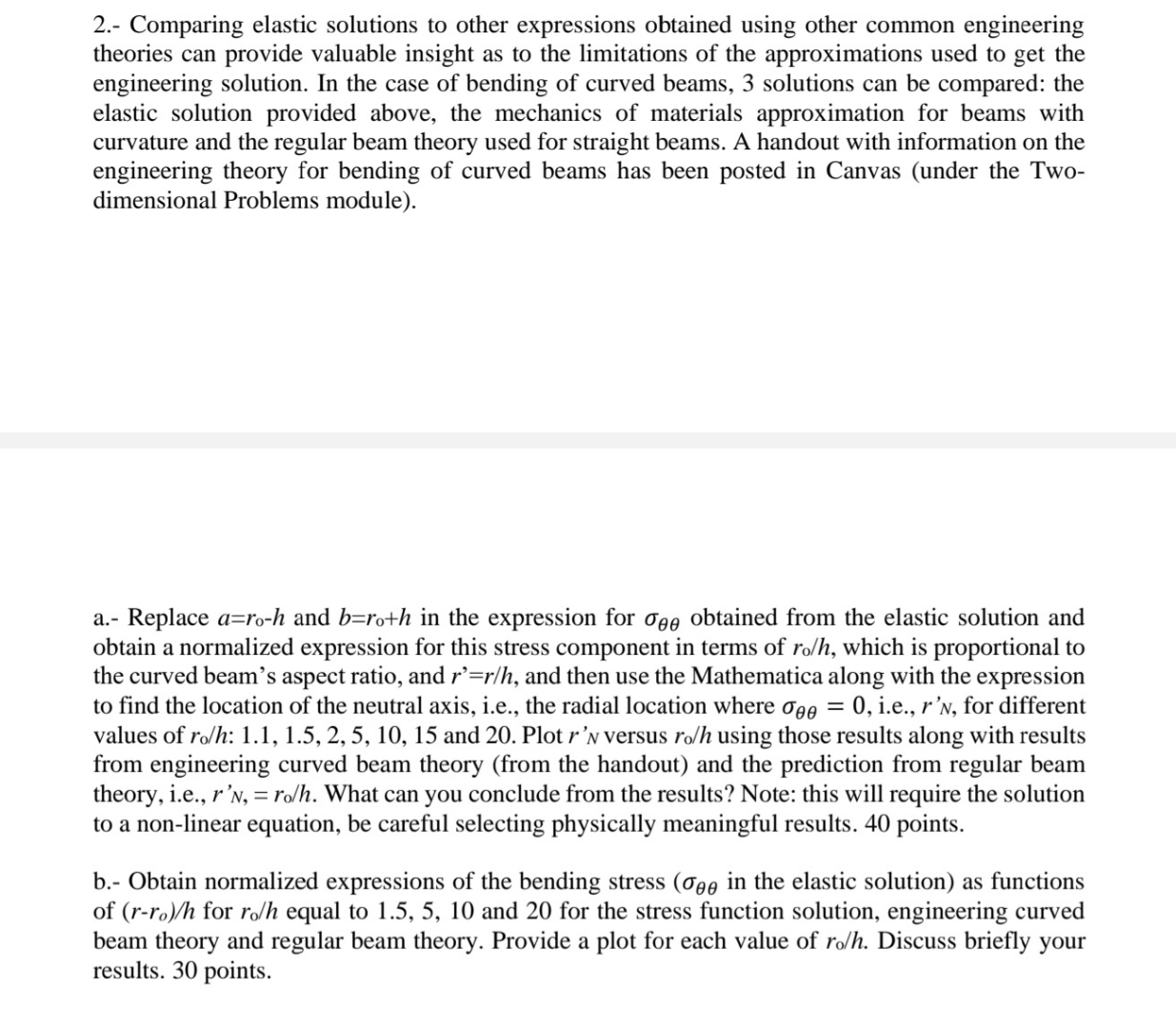
Comparing elastic solutions to other expressions obtained using other common engineering theories can provide valuable insight as to the limitations of the approximations used to get the engineering solution. In the case of bending of curved beams, solutions can be compared: the elastic solution provided above, the mechanics of materials approximation for beams with curvature and the regular beam theory used for straight beams. A handout with information on the engineering theory for bending of curved beams has been posted in Canvas under the Twodimensional Problems module
a Replace and in the expression for obtained from the elastic solution and obtain a normalized expression for this stress component in terms of which is proportional to the curved beam's aspect ratio, and and then use the Mathematica along with the expression to find the location of the neutral axis, ie the radial location where ie for different values of : and Plot versus using those results along with results from engineering curved beam theory from the handout and the prediction from regular beam theory, ie What can you conclude from the results? Note: this will require the solution to a nonlinear equation, be careful selecting physically meaningful results. points.
b Obtain normalized expressions of the bending stress in the elastic solution as functions of for equal to and for the stress function solution, engineering curved beam theory and regular beam theory. Provide a plot for each value of Discuss briefly your results. points.
Step by Step Solution
There are 3 Steps involved in it
1 Expert Approved Answer
Step: 1 Unlock

Question Has Been Solved by an Expert!
Get step-by-step solutions from verified subject matter experts
Step: 2 Unlock
Step: 3 Unlock
 Study Help