



Question: 2. Compute the costs per equivalent unit for the month. (Round your answers to 3 decimal places.) Required: Prepare a production report for the cooking
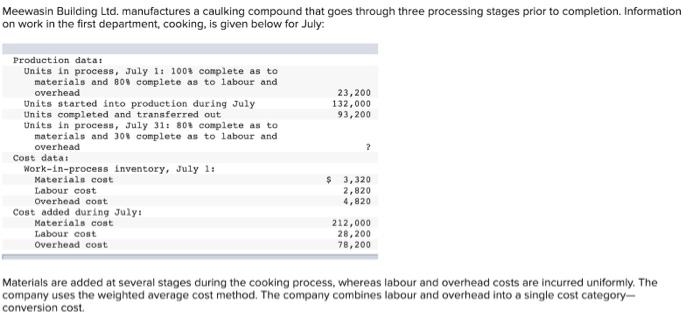
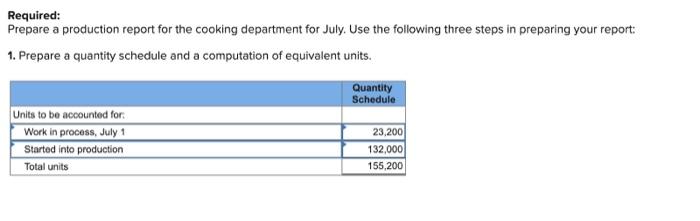
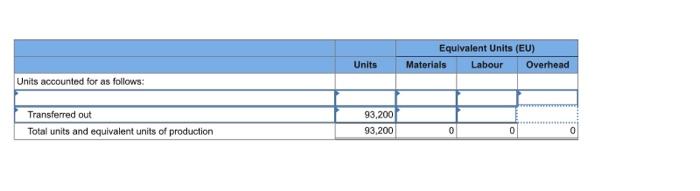
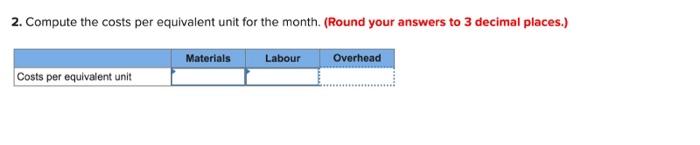
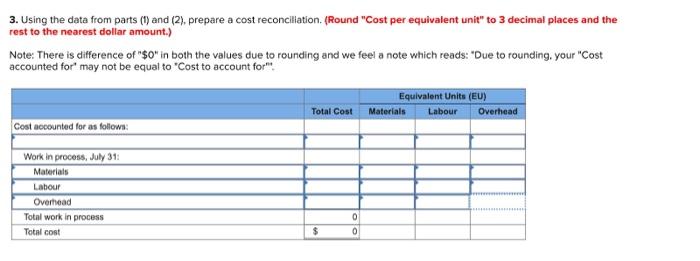
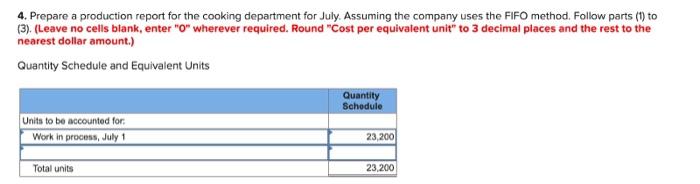
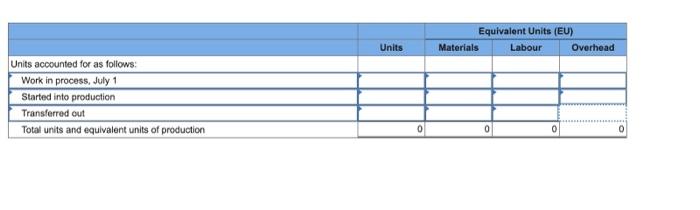
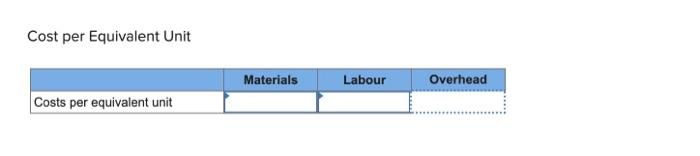
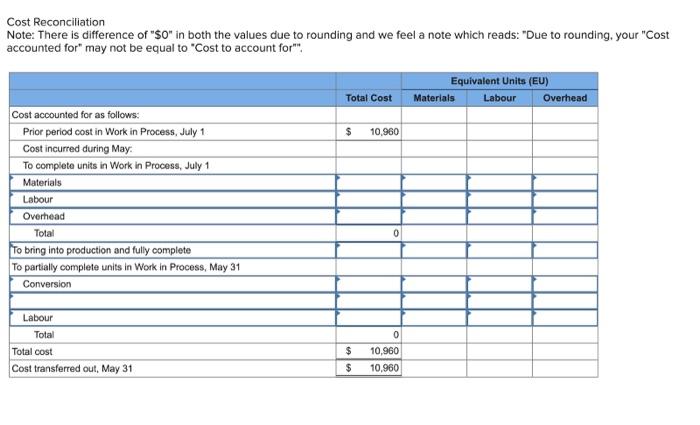
2. Compute the costs per equivalent unit for the month. (Round your answers to 3 decimal places.) Required: Prepare a production report for the cooking department for July. Use the following three steps in preparing your report: 1. Prepare a quantity schedule and a computation of equivalent units. Meewasin Building Ltd. manufactures a caulking compound that goes through three processing stages prior to completion. Information on work in the first department, cooking, is given below for July: Materials are added at several stages during the cooking process, whereas labour and overhead costs are incurred uniformly. The company uses the weighted average cost method. The company combines labour and overhead into a single cost categoryconversion cost. Cost Reconciliation Note: There is difference of " $0 " in both the values due to rounding and we feel a note which reads: "Due to rounding. your "Cost accounted for" may not be equal to "Cost to account for"'. \begin{tabular}{|c|c|c|c|c|} \hline & \multirow[b]{2}{*}{ Units } & \multicolumn{3}{|c|}{ Equivalent Units (EU) } \\ \hline & & Materials & Labour & Overhead \\ \hline \multicolumn{5}{|l|}{ Units accounted for as follows: } \\ \hline \multicolumn{5}{|l|}{ Work in process, July 1} \\ \hline \multicolumn{5}{|l|}{ Started into production } \\ \hline \multicolumn{5}{|l|}{ Transferred out } \\ \hline Total units and equivalent units of production & 0 & 0 & 0 & 0 \\ \hline \end{tabular} \begin{tabular}{|c|c|c|c|c|} \hline & \multirow[b]{2}{*}{ Units } & \multicolumn{3}{|c|}{ Equivalent Units (EU) } \\ \hline & & Materials & Labour & Overhead \\ \hline \multicolumn{5}{|l|}{ Units accounted for as follows: } \\ \hline \\ \hline Transferred out & 93,200 & & & \\ \hline Total units and equivalent units of production & 93,200 & 0 & 0 & 0 \\ \hline \end{tabular} Cost per Equivalent Unit 4. Prepare a production report for the cooking department for July. Assuming the company uses the FIFO method. Follow parts (1) to (3). (Leave no cells blank, enter " O " wherever required. Round "Cost per equivalent unit" to 3 decimal places and the rest to the nearest dollar amount.) 3. Using the data from parts (1) and (2), prepare a cost reconciliation. (Round "Cost per equivalent unit" to 3 decimal places and the rest to the nearest dollar amount.) Note: There is difference of "\$0" in both the values due to rounding and we feel a note which reads: "Due to rounding. your "Cost accounted for" may not be equal to "Cost to account for
Step by Step Solution
There are 3 Steps involved in it

Get step-by-step solutions from verified subject matter experts