





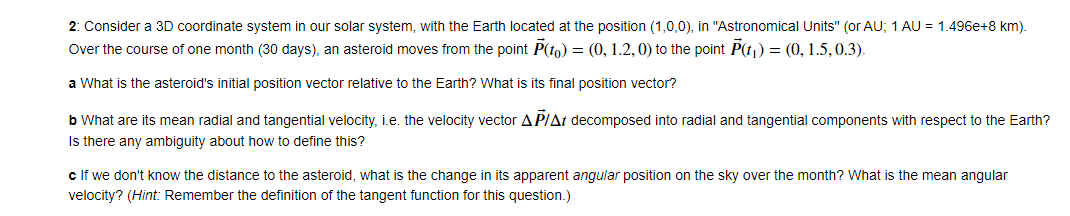
Question: 2: Consider a 3D coordinate system in our solar system, with the Earth located at the position (1,0,0), in Astronomical Units (or AU; 1 AU
2: Consider a 3D coordinate system in our solar
2: Consider a 3D coordinate system in our solar system, with the Earth located at the position (1,0,0), in "Astronomical Units" (or AU; 1 AU = 1.496e+8 km). Over the course of one month (30 days), an asteroid moves from the point P(to) = (0, 1.2, () to the point P(, ) = (0, 1.5, 0.3). a What is the asteroid's initial position vector relative to the Earth? What is its final position vector? b What are its mean radial and tangential velocity, i.e. the velocity vector A P/Ar decomposed into radial and tangential components with respect to the Earth? Is there any ambiguity about how to define this? c If we don't know the distance to the asteroid, what is the change in its apparent angular position on the sky over the month? What is the mean angular velocity? (Hint: Remember the definition of the tangent function for this question.)

Step by Step Solution

There are 3 Steps involved in it

1 Expert Approved Answer
Step: 1 Unlock blur-text-image
Question Has Been Solved by an Expert!

Get step-by-step solutions from verified subject matter experts

Step: 2 Unlock
Step: 3 Unlock

Students Have Also Explored These Related Mathematics Questions!