







Question: 2 . Consider a catheter inserted into a blood vessel. For this problem, make the ( silly ) assumption that there is no blood flow
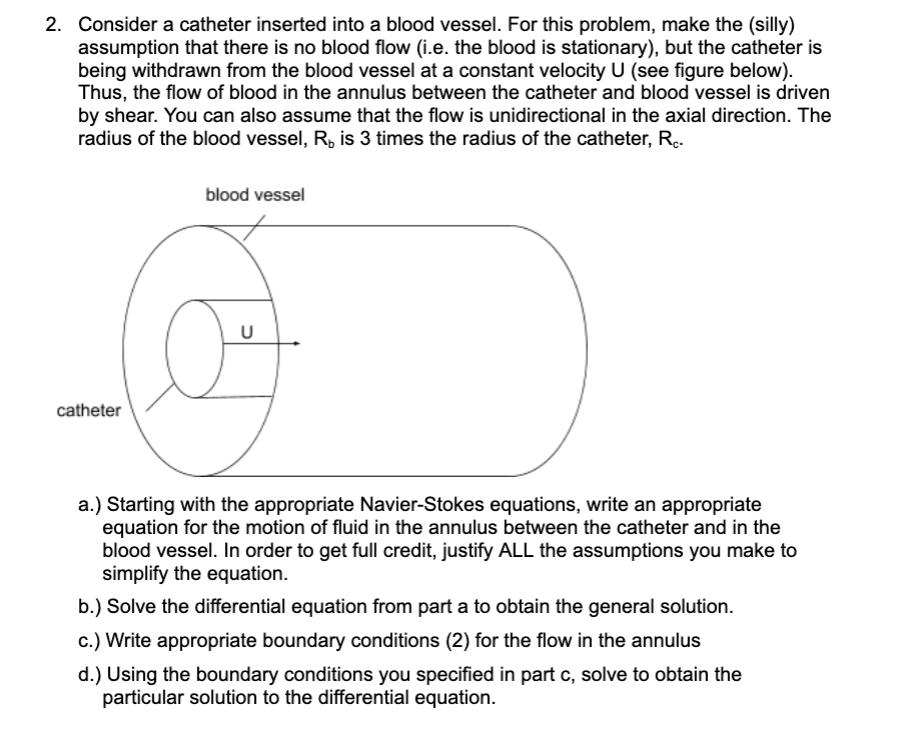
Consider a catheter inserted into a blood vessel. For this problem, make the silly assumption that there is no blood flow ie the blood is stationary but the catheter is being withdrawn from the blood vessel at a constant velocity U see figure below Thus, the flow of blood in the annulus between the catheter and blood vessel is driven by shear. You can also assume that the flow is unidirectional in the axial direction. The radius of the blood vessel, Rb is times the radius of the catheter, Rc
a Starting with the appropriate NavierStokes equations, write an appropriate equation for the motion of fluid in the annulus between the catheter and in the blood vessel. In order to get full credit, justify ALL the assumptions you make to simplify the equation.
b Solve the differential equation from part a to obtain the general solution.
c Write appropriate boundary conditions for the flow in the annulus
d Using the boundary conditions you specified in part c solve to obtain the particular solution to the differential equation.
Please wrote it out instead of typing it out. I understand there is AI but I looked at other solution and it's really confusing. Thank you.
Step by Step Solution
There are 3 Steps involved in it
1 Expert Approved Answer
Step: 1 Unlock

Question Has Been Solved by an Expert!
Get step-by-step solutions from verified subject matter experts
Step: 2 Unlock
Step: 3 Unlock
 Study Help