







Question: 2. Consider a hard disk with 2 platters. Each platter has two recording surfaces (top and bottom). Each surface has 100,000 tracks. Each track holds
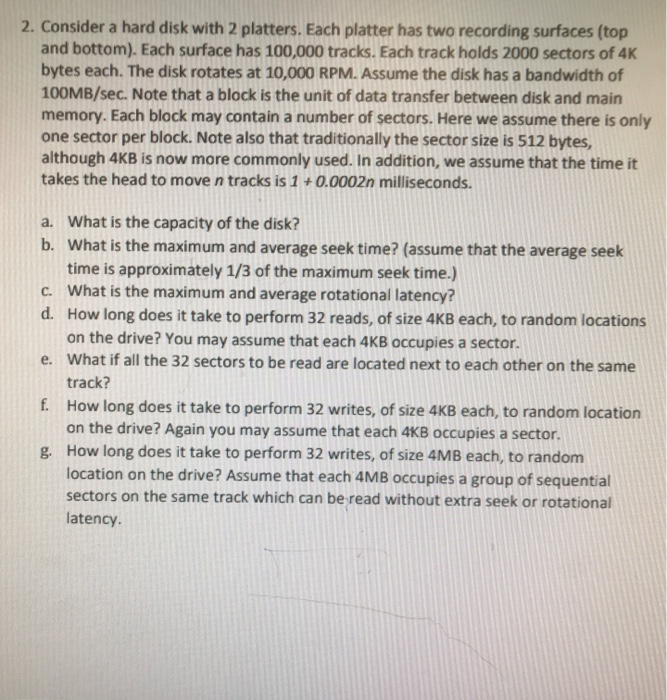
2. Consider a hard disk with 2 platters. Each platter has two recording surfaces (top and bottom). Each surface has 100,000 tracks. Each track holds 2000 sectors of 4K bytes each. The disk rotates at 10,000 RPM. Assume the disk has a bandwidth of 100MB/sec. Note that a block is the unit of data transfer between disk and main memory. Each block may contain a number of sectors. Here we assume there is only one sector per block. Note also that traditionally the sector size is 512 bytes although 4KB is now more commonly used. In addition, we assume that the time it takes the head to move n tracks is 1 +0.0002n milliseconds. What is the capacity of the disk? What is the maximum and average seek time? (assume that the average seek time is approximately 1/3 of the maximum seek time.) What is the maximum and average rotational latency? a. b. c. d. How long does it take to perform 32 reads, of size 4KB each, to random locations e. What if all the 32 sectors to be read are located next to each other on the same f. How long does it take to perform 32 writes, of size 4KB each, to random location g How long does it take to perform 32 writes, of size 4MB each, to random on the drive? You may assume that each 4KB occupies a sector. track? on the drive? Again you may assume that each 4KB occupies a sector. location on the drive? Assume that each 4MB occupies a group of sequential sectors on the same track which can be read without extra seek or rotational latency
Step by Step Solution
There are 3 Steps involved in it

Get step-by-step solutions from verified subject matter experts
 Study Help