







Question: 2. Consider a market with aggregate demand function x(p)=74p, (1) in which every potential firm has cost function c(q)=18+2q+0.5q 2 . (2) (a) Calculate the
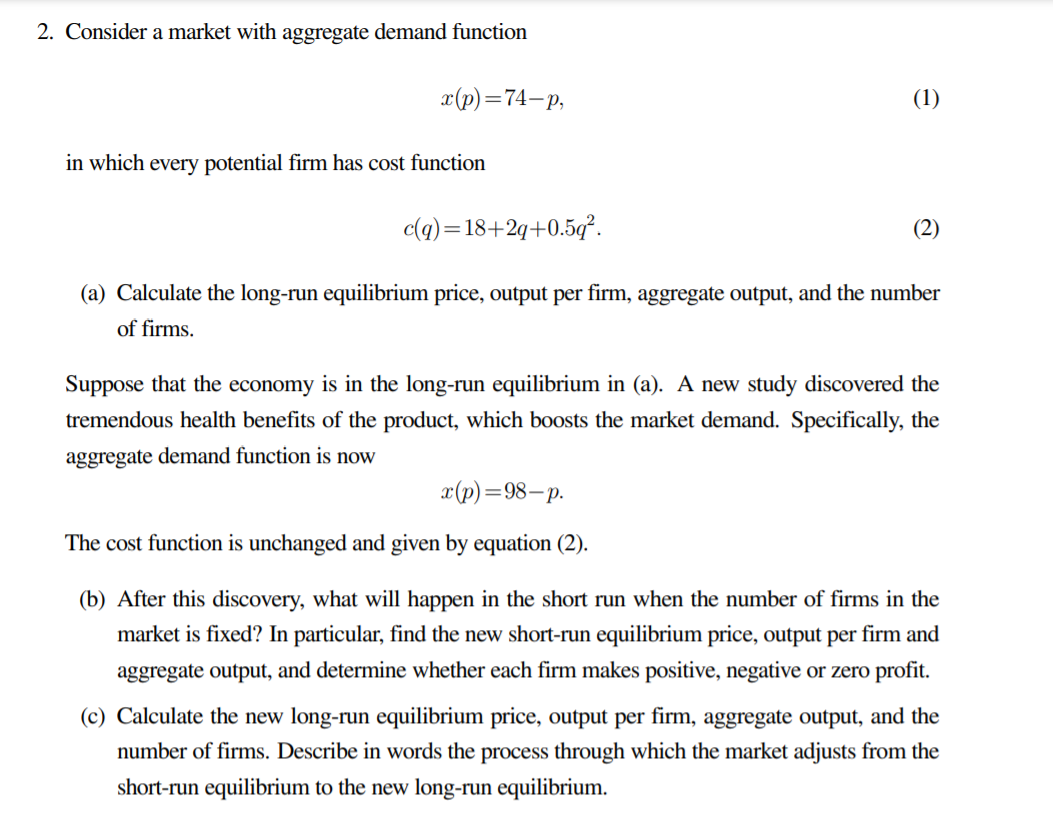 2. Consider a market with aggregate demand function x(p)=74p, (1) in which every potential firm has cost function c(q)=18+2q+0.5q 2 . (2) (a) Calculate the long-run equilibrium price, output per firm, aggregate output, and the number of firms. Suppose that the economy is in the long-run equilibrium in (a). A new study discovered the tremendous health benefits of the product, which boosts the market demand. Specifically, the aggregate demand function is now x(p)=98p. The cost function is unchanged and given by equation (2). (b) After this discovery, what will happen in the short run when the number of firms in the market is fixed? In particular, find the new short-run equilibrium price, output per firm and aggregate output, and determine whether each firm makes positive, negative or zero profit. (c) Calculate the new long-run equilibrium price, output per firm, aggregate output, and the number of firms. Describe in words the process through which the market adjusts from the short-run equilibrium to the new long-run equilibrium.
2. Consider a market with aggregate demand function x(p)=74-p, (1) in which every potential firm has cost function c(q)=18+2q+0.592 (2 (2) (a) Calculate the long-run equilibrium price, output per firm, aggregate output, and the number of firms. Suppose that the economy is in the long-run equilibrium in (a). A new study discovered the tremendous health benefits of the product, which boosts the market demand. Specifically, the aggregate demand function is now x(p)=98-p. The cost function is unchanged and given by equation (2). (b) After this discovery, what will happen in the short run when the number of firms in the market is fixed? In particular, find the new short-run equilibrium price, output per firm and aggregate output, and determine whether each firm makes positive, negative or zero profit. (c) Calculate the new long-run equilibrium price, output per firm, aggregate output, and the number of firms. Describe in words the process through which the market adjusts from the short-run equilibrium to the new long-run equilibrium. 2. Consider a market with aggregate demand function x(p)=74-p, (1) in which every potential firm has cost function c(q)=18+2q+0.592 (2 (2) (a) Calculate the long-run equilibrium price, output per firm, aggregate output, and the number of firms. Suppose that the economy is in the long-run equilibrium in (a). A new study discovered the tremendous health benefits of the product, which boosts the market demand. Specifically, the aggregate demand function is now x(p)=98-p. The cost function is unchanged and given by equation (2). (b) After this discovery, what will happen in the short run when the number of firms in the market is fixed? In particular, find the new short-run equilibrium price, output per firm and aggregate output, and determine whether each firm makes positive, negative or zero profit. (c) Calculate the new long-run equilibrium price, output per firm, aggregate output, and the number of firms. Describe in words the process through which the market adjusts from the short-run equilibrium to the new long-run equilibrium
Step by Step Solution
There are 3 Steps involved in it

Get step-by-step solutions from verified subject matter experts
 Study Help