



Question: 2. Consider a particular substance. The isothermal compressibility and coefficient of thermal expansion are given by: T2 T K = C1 C2 VP3 T 1
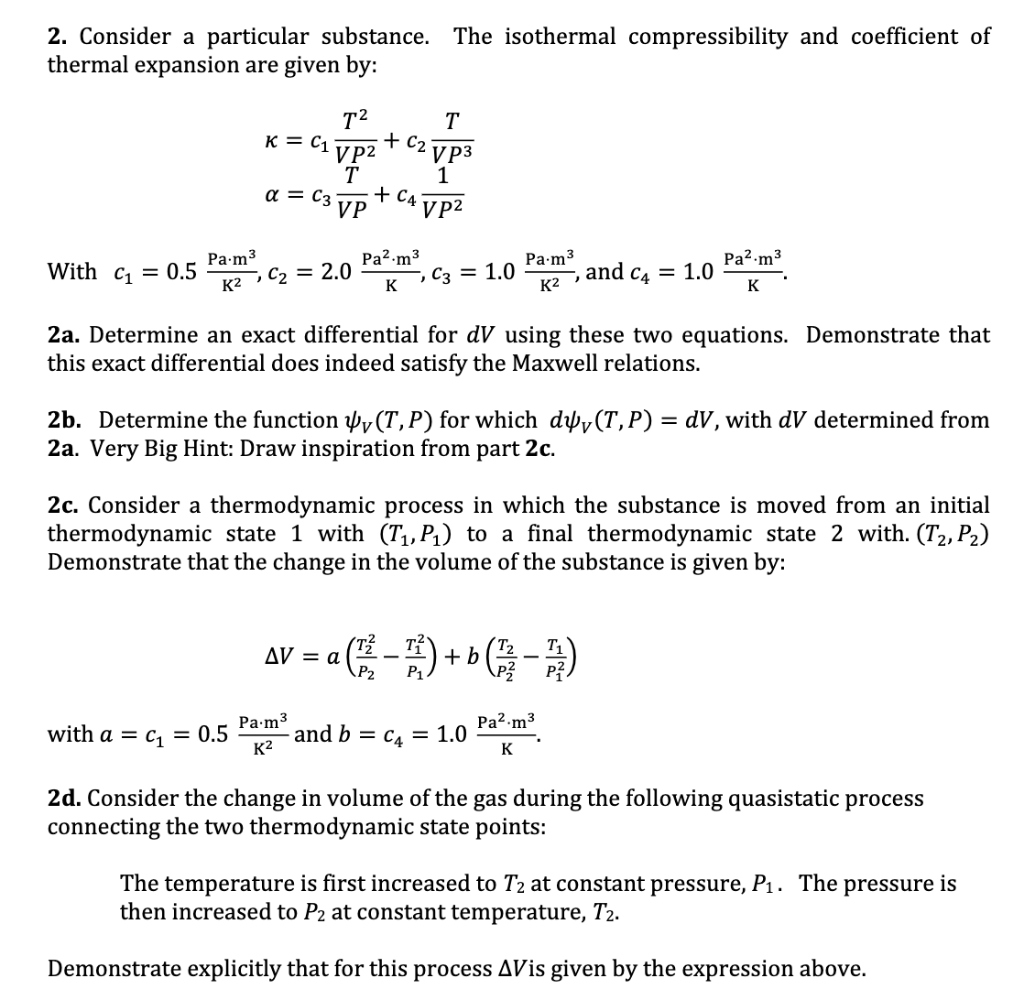
2. Consider a particular substance. The isothermal compressibility and coefficient of thermal expansion are given by: T2 T K = C1 C2 VP3 T 1 a = C3 +c4 VP VP2 vpa+c2 yps Pa.m3 With C1 = 0.5 Pa.m3 Pa.m 3 K 7 C3 = 1.0 and K2 C4 = 1.0 Pa.m3 K K2 ; C2 = 2.0 2a. Determine an exact differential for dV using these two equations. Demonstrate that this exact differential does indeed satisfy the Maxwell relations. = 2b. Determine the function Yv(T,P) for which dv(T,P) = dV, with dV determined from 2a. Very Big Hint: Draw inspiration from part 2c. 2c. Consider a thermodynamic process in which the substance is moved from an initial thermodynamic state 1 with (T1,P1) to a final thermodynamic state 2 with. (T2, P2) Demonstrate that the change in the volume of the substance is given by: AV = 2 (1-7)+b) b ( a T2 P2 P2 P1 with a = (1 = 0.5 Pam3 and b = C4 = 1.0 Pa2.m3 K2 K 2d. Consider the change in volume of the gas during the following quasistatic process connecting the two thermodynamic state points: The temperature is first increased to T2 at constant pressure, P1. The pressure is then increased to P2 at constant temperature, T2. Demonstrate explicitly that for this process AVis given by the expression above
Step by Step Solution
There are 3 Steps involved in it

Get step-by-step solutions from verified subject matter experts