







Question: 2 . consider a physics experiment where we are investigating the motion of a rocket along a curved path. The path is described by the
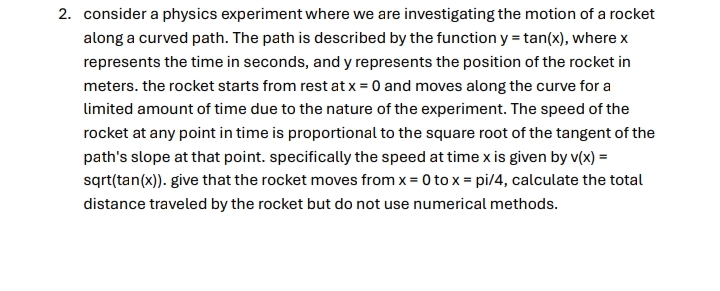
consider a physics experiment where we are investigating the motion of a rocket along a curved path. The path is described by the function ytan x where x represents the time in seconds, and y represents the position of the rocket in meters. the rocket starts from rest at x and moves along the curve for a limited amount of time due to the nature of the experiment. The speed of the rocket at any point in time is proportional to the square root of the tangent of the path's slope at that point. specifically the speed at time x is given by vxoperatornamesqrttan x give that the rocket moves from x to xp i calculate the total distance traveled by the rocket but do not use numerical methods.
Step by Step Solution
There are 3 Steps involved in it
1 Expert Approved Answer
Step: 1 Unlock

Question Has Been Solved by an Expert!
Get step-by-step solutions from verified subject matter experts
Step: 2 Unlock
Step: 3 Unlock
 Study Help